
Apache Hadoop End of Life - Dates and Lifecycle
Apache Hadoop is an open-source framework for distributed storage and processing of large datasets across clusters of commodity hardware.
Last updated 26 August 2026
18
Versions tracked
14
At EOL
4
Supported
All versions
| Version | Released | Support | Latest |
|---|---|---|---|
|
3.5
|
02 Apr 2026 |
Active
|
3.5.0
01 Apr 2026
|
|
3.4
|
17 Mar 2024 |
Active
|
3.4.3
24 Feb 2026
|
|
3.3
|
15 Jul 2020 |
Active
|
3.3.6
26 Jun 2023
|
|
2.10
|
29 Oct 2019 |
Active
|
2.10.2
31 May 2022
|
|
3.2
|
21 Jan 2019 |
21 Dec 2023
Ended 2 years, 9 months ago
|
3.2.4
22 Jul 2022
|
|
3.1
|
05 Apr 2018 |
18 Aug 2020
Ended 6 years, 1 month ago
|
3.1.4
18 Aug 2020
|
|
3.0
|
18 Dec 2017 |
10 Jun 2018
Ended 8 years, 4 months ago
|
3.0.3
10 Jun 2018
|
|
2.9
|
17 Nov 2017 |
20 Nov 2018
Ended 7 years, 10 months ago
|
2.9.2
20 Nov 2018
|
About Apache Hadoop
Enterprise data platforms built on Hadoop in the early 2010s are often still running it today, since it typically sits at the core of a company's broader data infrastructure and migrating off it is rarely a quick project, which is part of why version sprawl is common across real Hadoop deployments.
Apache Hadoop Lifecycle Explained
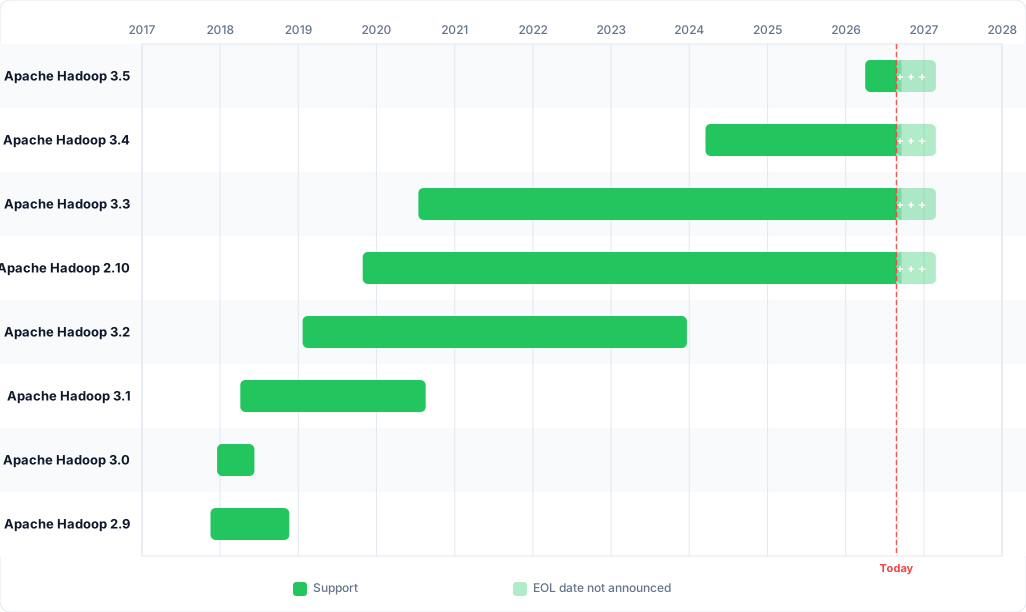
Hadoop's end of life process is driven entirely by volunteer availability, not a calendar. The project's own policy states plainly that a branch is declared end of life "if no volunteer to do a maintenance release in a short to mid-term (like 3 months to 1 or 1.5 year)," and even after that, the community can still choose to do a security-only release if someone steps up. This is why Hadoop currently has four simultaneously active branches, 2.10, 3.3, 3.4, and 3.5, rather than the usual pattern of retiring older lines once a new one ships: each stays open only as long as someone is actually willing to maintain it.
Frequently Asked Questions
Is Hadoop still relevant in 2026?
It remains widely deployed in existing enterprise data infrastructure, though newer projects increasingly reach for cloud-native or purpose-built tools instead of adopting Hadoop from scratch. Relevance for existing deployments and appeal for new ones are different questions, and Hadoop scores much higher on the former.
What is replacing Hadoop?
Cloud-native data platforms and managed services have taken over much of the greenfield workload Hadoop used to handle, along with more specialized tools for specific pieces of what Hadoop once did all at once, such as distributed SQL engines, object storage, and managed Spark services.
When was Hadoop 3 released?
Hadoop 3.0 was released on December 18, 2017, the first major version since Hadoop 2.0 in 2013.
What is the latest version of Apache Hadoop?
Hadoop 3.5.0 is the newest release, though 3.4, 3.3, and 2.10 are all still separately maintained branches rather than fully retired.