
Apache Velocity End of Life - Dates and Lifecycle
Apache Velocity is a Java-based template engine that generates dynamic web pages, source code, and other text output from templates, maintained by the Apache Software Foundation.
Last updated 7 September 2026
13
Versions tracked
12
At EOL
1
Supported
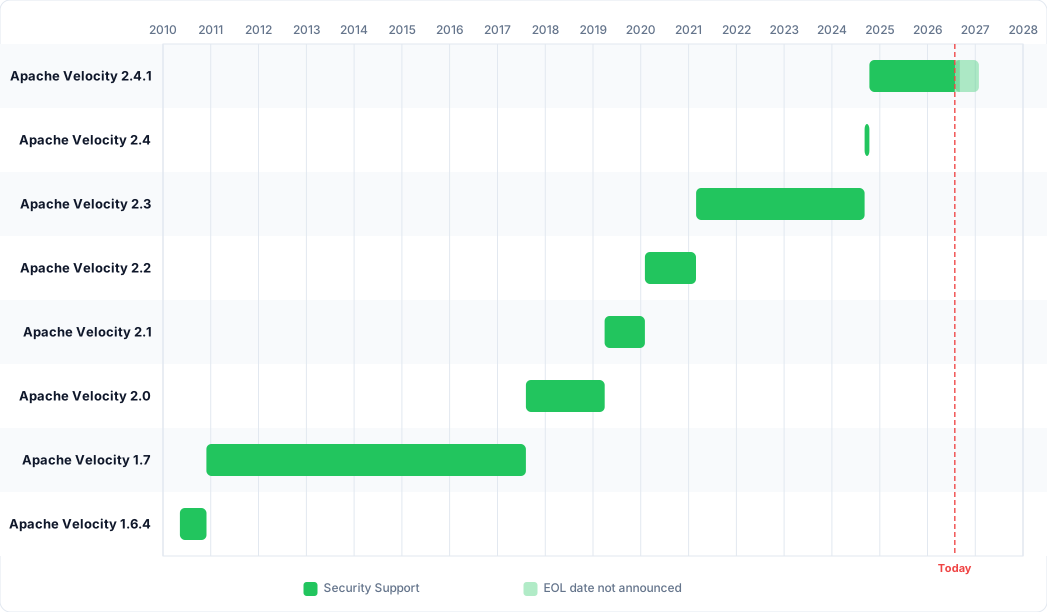
All versions
| Version | Released | Security Support | Latest |
|---|---|---|---|
|
2.4.1
|
14 Oct 2024 |
Active
|
— |
|
2.4
|
07 Sep 2024 |
14 Oct 2024
Ended 1 year, 11 months ago
|
— |
|
2.3
|
27 Feb 2021 |
07 Sep 2024
Ended 2 years ago
|
— |
|
2.2
|
02 Feb 2020 |
27 Feb 2021
Ended 5 years, 6 months ago
|
— |
|
2.1
|
31 Mar 2019 |
02 Feb 2020
Ended 6 years, 7 months ago
|
— |
|
2.0
|
06 Aug 2017 |
31 Mar 2019
Ended 7 years, 5 months ago
|
— |
|
1.7
|
29 Nov 2010 |
06 Aug 2017
Ended 9 years, 1 month ago
|
— |
|
1.6.4
|
10 May 2010 |
29 Nov 2010
Ended 15 years, 9 months ago
|
— |
About Apache Velocity
Apache Velocity has been a stable, if slow-moving, part of the Java ecosystem since the early 2000s, often paired with tools like Spring or used standalone for code and document generation. It's a Java-based template engine that generates dynamic web pages, source code, configuration files, and other text output by combining templates with data.
Apache Velocity Lifecycle Explained
Apache Velocity has no formal end of life policy, and unlike most software covered on this site, that isn't an inference, it's something a project maintainer stated directly. In response to a user asking about EOL versions on the Velocity mailing list, developer Nathan Bubna replied plainly: "there are no technically EOL versions of Velocity... we're just not that big or fast moving of a project. Things change only very slowly around here, as the project is stable and the team is small and busy... support is volunteer-based, so if someone wants to support you and answer your question, they do."
That description matches the release history closely. Velocity Engine 2.0 shipped seven years after 1.7. A sandbox bypass vulnerability (CVE-2020-13936, allowing arbitrary Java code execution through untrusted templates) affected every version up through 2.2, but the fix in 2.3 didn't ship until over a year later. There's no scheduled patching cadence, and no guarantee that any given issue, security or otherwise, will be addressed quickly, or at all, since the project runs entirely on volunteer time.
Velocity also ships a closely related but separately versioned Tools package, which provides supporting utilities for web and standalone applications built on the Velocity Engine. Tools 3.1, for example, was released alongside Engine 2.3 and specifically patches its own XSS vulnerability (CVE-2020-13959), so it's worth tracking Tools versions alongside the core Engine version rather than assuming Engine security fixes cover it too.
Frequently Asked Questions
Are there end-of-life versions of Apache Velocity?
Not in any official sense. A Velocity project maintainer has stated directly that the project doesn't track or declare EOL versions, since it's a small, volunteer-run project with no formal support commitments. In practice, older versions simply stop getting attention as maintainers move on, rather than being formally retired.
What is Apache Velocity used for?
It's used to generate dynamic text output, most commonly HTML for web pages, but also source code, configuration files, and emails, by combining templates written in Velocity Template Language (VTL) with data supplied by a Java application.
Is Apache Velocity still maintained?
Yes, though slowly. Velocity Engine 2.4.1 released in October 2024, and the project continues to receive occasional releases. Given its own maintainers describe it as small and volunteer-run, response times to new issues can be considerably slower than commercially backed software.
Is Velocity Engine 2.2 vulnerable?
Yes. Velocity Engine versions up through 2.2 are affected by CVE-2020-13936, a sandbox bypass that can allow arbitrary Java code execution in applications that let untrusted users upload or modify templates. The fix shipped in version 2.3.