
Debian End of Life - Dates and Lifecycle
Debian is a free, community-developed Linux distribution known for stability and a strict release process, and the base for derivatives like Ubuntu, Kali, and Raspberry Pi OS.
Last updated 8 August 2026
18
Versions tracked
16
At EOL
2
Supported
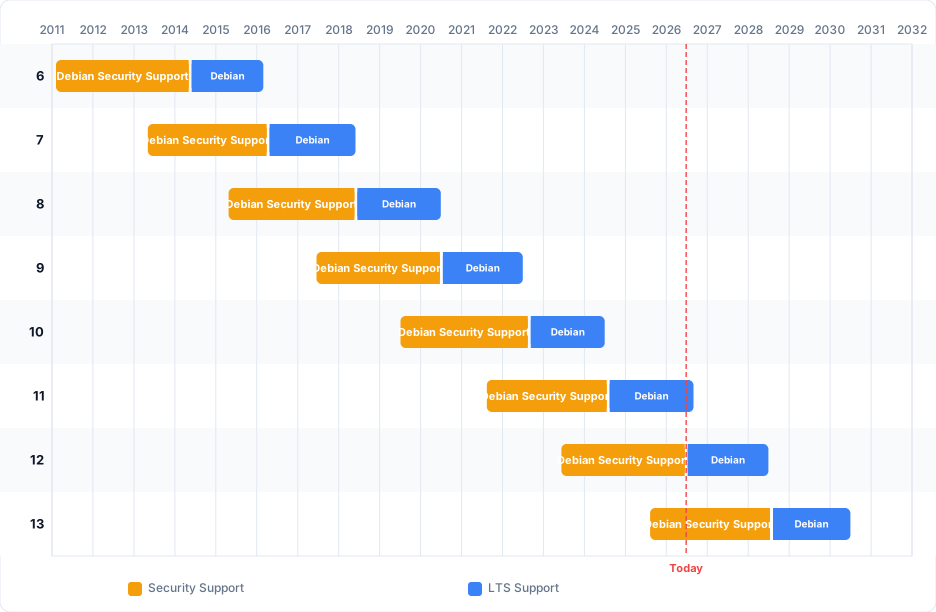
All versions
| Version | Released | Debian Security Support | Debian LTS | Latest |
|---|---|---|---|---|
|
13
|
09 Aug 2025 |
09 Aug 2028
Ends in 1 year, 10 months
|
30 Jun 2030
Ends in 3 years, 9 months
|
13.7
12 Sep 2026
|
|
12
|
10 Jun 2023 |
11 Jul 2026
Ended 2 months, 2 weeks ago
|
30 Jun 2028
Ends in 1 year, 9 months
|
12.15
11 Jul 2026
|
|
11
|
14 Aug 2021 |
14 Aug 2024
Ended 2 years, 1 month ago
|
31 Aug 2026
Ended 3 weeks ago
|
11.11
31 Aug 2024
|
|
10
|
06 Jul 2019 |
10 Sep 2022
Ended 4 years ago
|
30 Jun 2024
Ended 2 years, 2 months ago
|
10.13
10 Sep 2022
|
|
9
|
17 Jun 2017 |
18 Jul 2020
Ended 6 years, 2 months ago
|
01 Jul 2022
Ended 4 years, 2 months ago
|
9.13
18 Jul 2020
|
|
8
|
25 Apr 2015 |
17 Jun 2018
Ended 8 years, 3 months ago
|
30 Jun 2020
Ended 6 years, 2 months ago
|
8.11
23 Jun 2018
|
|
7
|
04 May 2013 |
25 Apr 2016
Ended 10 years, 5 months ago
|
31 May 2018
Ended 8 years, 3 months ago
|
7.11
04 Jun 2016
|
|
6
|
06 Feb 2011 |
31 May 2014
Ended 12 years, 4 months ago
|
29 Feb 2016
Ended 10 years, 7 months ago
|
6.0.10
19 Jul 2014
|
About Debian
Debian releases are known by codename as much as by number, Bullseye, Bookworm, Trixie, rather than just a version number, and each one goes through a longer, more layered support process than most Linux distributions. A release doesn't simply flip from supported to unsupported on one date, it moves through several distinct phases, each with a different scope of coverage, which makes "is Debian X end of life" a more nuanced question than it looks.
Debian Lifecycle Explained
Each Debian release gets three years of regular security support from the Debian Security Team, covering the full package archive, starting from its initial release date. Once that closes, the release doesn't go dark, it moves into Debian Long Term Support (LTS) for another two years, bringing official coverage to five years total. LTS is narrower than regular support though: not every package gets maintained during this phase, only ones with an active sponsor, and the set of supported architectures shrinks too. For internet-facing or dependency-heavy systems, it's worth checking the Debian LTS tracker for your specific packages rather than assuming full coverage carries over.
Beyond the five-year official window, a commercial Extended LTS (ELTS) offering from Freexian, not an official Debian project, can stretch coverage to ten years total for organizations that need it. New Debian releases arrive roughly every two years, so there are typically two or three versions somewhere in the regular support, LTS, or ELTS pipeline at once, with older codenames rotating out of coverage as new ones ship.
Frequently Asked Questions
Is Debian 12 end of life?
Not yet, and it's a good example of how Debian's phased model works. Debian 12 (Bookworm)'s three years of regular support close in July 2026, but rather than going unsupported, it then moves straight into LTS through June 2028. It's narrower coverage than before, but it isn't end of life yet.
How long is Debian supported for?
Five years through official channels, three years of regular support plus two years of LTS. Organizations that need coverage beyond that can use commercial Extended LTS, which pushes total support to around ten years, though that's a third-party offering rather than something Debian itself provides.
What will Debian 14 be called?
Forky. It's currently Debian's testing branch codename and is expected to become the stable Debian 14 release around 2027, following Debian's roughly two-year release cadence.
Is Debian 13 released?
Yes. Debian 13, codenamed Trixie, released on August 9, 2025, and is the current stable version. The latest version, Debian 13.6, was released on July 11, 2026. Its regular security support runs through August 2028, with LTS extending coverage to June 2030 after that.