

.NET End of Life - Dates and Lifecycle
.NET is Microsoft's free, cross-platform development framework for building web, cloud, desktop, and mobile applications, spanning the modern .NET runtime and the older .NET Framework.
Last updated 8 August 2026
13
Versions tracked
10
At EOL
3
Supported
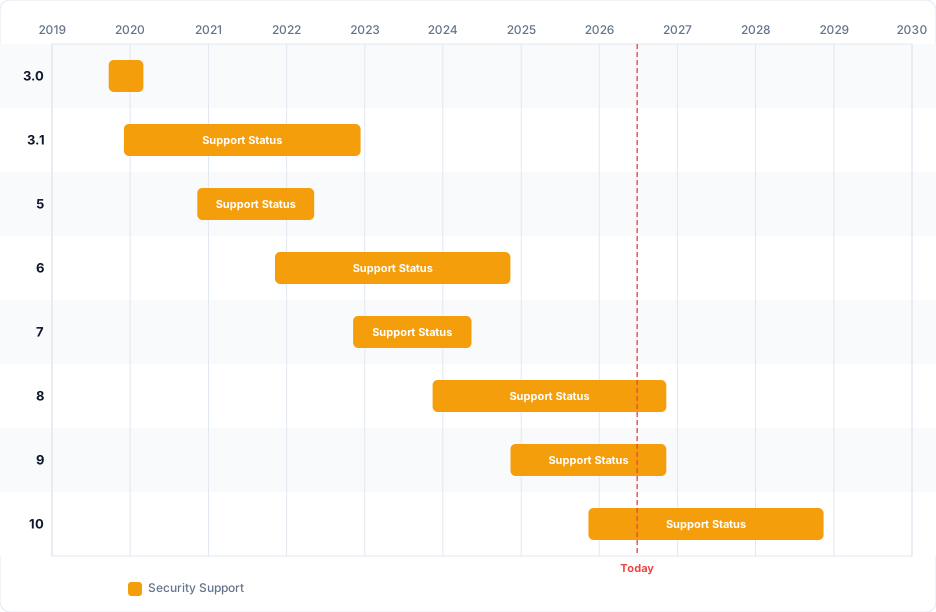
All versions
| Version | Released | Support Status | Latest |
|---|---|---|---|
|
10
LTS
|
11 Nov 2025 |
14 Nov 2028
Ends in 2 years, 1 month
|
10.0.12
08 Sep 2026
|
|
9
|
12 Nov 2024 |
10 Nov 2026
Ends in 1 month, 2 weeks
|
9.0.20
08 Sep 2026
|
|
8
LTS
|
14 Nov 2023 |
10 Nov 2026
Ends in 1 month, 2 weeks
|
8.0.31
08 Sep 2026
|
|
7
|
08 Nov 2022 |
14 May 2024
Ended 2 years, 4 months ago
|
7.0.20
29 May 2024
|
|
6
LTS
|
08 Nov 2021 |
12 Nov 2024
Ended 1 year, 10 months ago
|
6.0.36
12 Nov 2024
|
|
5
|
10 Nov 2020 |
10 May 2022
Ended 4 years, 4 months ago
|
5.0.17
10 May 2022
|
|
3.1
LTS
|
03 Dec 2019 |
13 Dec 2022
Ended 3 years, 9 months ago
|
3.1.32
13 Dec 2022
|
|
3.0
|
23 Sep 2019 |
03 Mar 2020
Ended 6 years, 6 months ago
|
3.0.3
19 Feb 2020
|
About .NET
.NET covers two different things that share a name but not a support model: the modern, cross-platform .NET runtime (.NET 6, 8, 9, 10, and onward) and the older Windows-only .NET Framework (up through 4.8), which most enterprise Windows applications were built on for over a decade. Knowing which one you're running matters, because their end of life dates, often abbreviated EOL, work completely differently.
.NET Lifecycle Explained
Modern .NET ships a new major version every November, and each release is assigned one of two support tracks at launch. Even-numbered releases, like .NET 6, 8, and 10, get Long Term Support (LTS) for three years from general availability. Odd-numbered releases, like .NET 7 and .NET 9, get Standard Term Support (STS), originally 18 months but extended to 24 months starting with .NET 9, announced in September 2025. That change had a notable side effect: .NET 8 (LTS) and .NET 9 (STS) now both reach end of life on the same day, November 10, 2026, since the extended STS window happened to land on .NET 8's existing LTS end date.
The .NET Framework operates on an entirely different model. Rather than a fixed support window, its lifecycle is tied to the Windows operating system version it ships with. .NET Framework 4.8, for example, has no announced end of life date because it's supported for as long as the underlying Windows release it's bundled with remains supported, which in practice can stretch well beyond the support window of far newer .NET versions. Older .NET Framework releases (like 3.5) have their own separate, extended timelines set by Microsoft's Windows lifecycle policies rather than the annual .NET release cadence.
Regardless of which track a version is on, once it's out of support, Microsoft stops shipping fixes, updates, and online technical assistance for it. Any vulnerability discovered afterward stays unpatched by Microsoft.
Frequently Asked Questions
When is .NET 8 end of life?
.NET 8 is a Long Term Support release, and it reaches end of life on November 10, 2026, three years after its initial release.
When is .NET 9 end of life?
.NET 9 also reaches end of life on November 10, 2026. It's a Standard Term Support release, and Microsoft's 2025 extension of STS support from 18 to 24 months moved its end date onto the same day as .NET 8's.
When is .NET Framework 4.8 end of life?
There's no set end of life date for .NET Framework 4.8. It's supported for as long as the version of Windows it ships with remains supported by Microsoft, which is a fundamentally different model than the fixed, version-based lifecycle used for modern .NET.
What's the difference between LTS and STS in .NET?
Both tracks ship with the same code quality and are equally production-ready, the only difference is how long they're supported. LTS releases (even-numbered) get three years of support and are the safer default for most production systems. STS releases (odd-numbered) get 24 months and suit teams that want to stay closer to the latest features and are willing to upgrade more often.