
MariaDB End of Life - Dates and Lifecycle
MariaDB is an open-source relational database created by the original developers of MySQL, built as a drop-in replacement and guaranteed to stay open source.
Last updated 16 September 2026
30
Versions tracked
25
At EOL
5
Supported
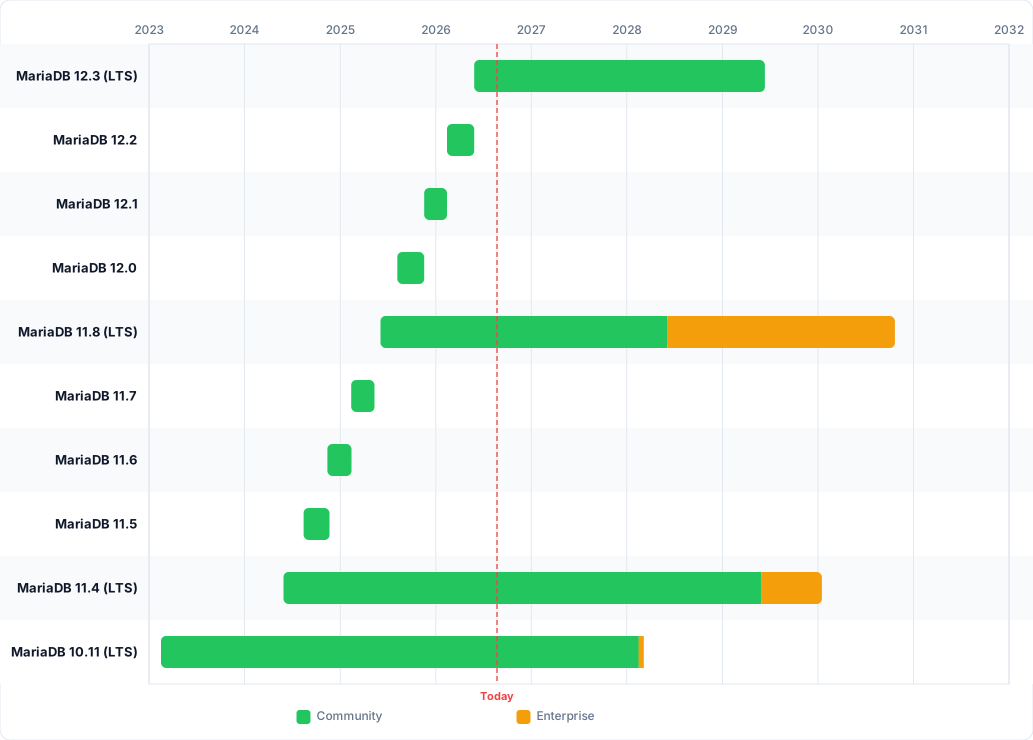
All versions
| Version | Released | Community | Enterprise | Latest |
|---|---|---|---|---|
|
13.0
|
15 Sep 2026 |
31 Dec 2026
Ends in 2 months, 3 weeks
|
Active
|
13.0.2
14 Sep 2026
|
|
12.3
LTS
|
28 May 2026 |
12 Jun 2029
Ends in 2 years, 8 months
|
Active
|
12.3.3
24 Aug 2026
|
|
12.2
|
13 Feb 2026 |
28 May 2026
Ended 4 months, 1 week ago
|
— |
12.2.2
12 Feb 2026
|
|
12.1
|
18 Nov 2025 |
13 Feb 2026
Ended 7 months, 3 weeks ago
|
— |
12.1.2
18 Nov 2025
|
|
12.0
|
07 Aug 2025 |
18 Nov 2025
Ended 10 months, 3 weeks ago
|
— |
12.0.2
07 Aug 2025
|
|
11.8
LTS
|
04 Jun 2025 |
04 Jun 2028
Ends in 1 year, 8 months
|
22 Oct 2030
Ends in 4 years
|
11.8.9
24 Aug 2026
|
|
11.7
|
12 Feb 2025 |
12 May 2025
Ended 1 year, 4 months ago
|
— |
11.7.2
12 Feb 2025
|
|
11.6
|
13 Nov 2024 |
13 Feb 2025
Ended 1 year, 7 months ago
|
— |
11.6.2
13 Nov 2024
|
About MariaDB
MariaDB was created by the original developers of MySQL after Oracle's acquisition of Sun Microsystems, built as a drop-in replacement and explicitly guaranteed to stay open source. Notable users include Wikipedia, WordPress.com, and Google, and it's the default database on many managed hosting platforms.
MariaDB Lifecycle Explained
MariaDB ships two kinds of releases. Rolling releases arrive roughly every quarter, each superseded by the next with a single Community support window and no extended tiers. Long-term releases (LTS), announced yearly, get a fuller support structure: Community binaries for 3 years from GA (5 years for releases up to MariaDB 11.4), plus optional Enterprise support through MariaDB Corporation for organizations that need coverage beyond that. Critical and security fixes are also provided in source code for 2 additional years beyond the Community binary period, even without an Enterprise subscription.
Frequently Asked Questions
Has MariaDB replaced MySQL?
Not universally, but it's a common substitute. MariaDB was built as a compatible drop-in replacement for MySQL by MySQL's original developers, and many distributions and hosting providers now default to MariaDB instead of MySQL, though both remain actively developed, separate projects.
Is MariaDB or MySQL faster?
This depends heavily on the workload, version, and configuration being compared, and benchmark results vary by use case rather than pointing to one database being universally faster. Neither has a consistent, unconditional performance advantage across all scenarios.
What are the drawbacks of MariaDB?
Common concerns include a smaller ecosystem of third-party tools and managed services compared to MySQL, occasional compatibility gaps with newer MySQL-specific features as the two projects diverge further over time, and a somewhat more fragmented documentation experience across MariaDB Foundation and MariaDB Corporation resources.
Is MariaDB 10.6 still supported?
Community support for MariaDB 10.6 ended July 6, 2026. Organizations with an Enterprise subscription can continue receiving support through August 2028.