
PostgreSQL End of Life - Dates and Lifecycle
PostgreSQL is an open-source object-relational database known for standards compliance, extensibility, and reliability, widely used in production by companies like Apple, Instagram, and Spotify.
Last updated 6 September 2026
29
Versions tracked
24
At EOL
5
Supported
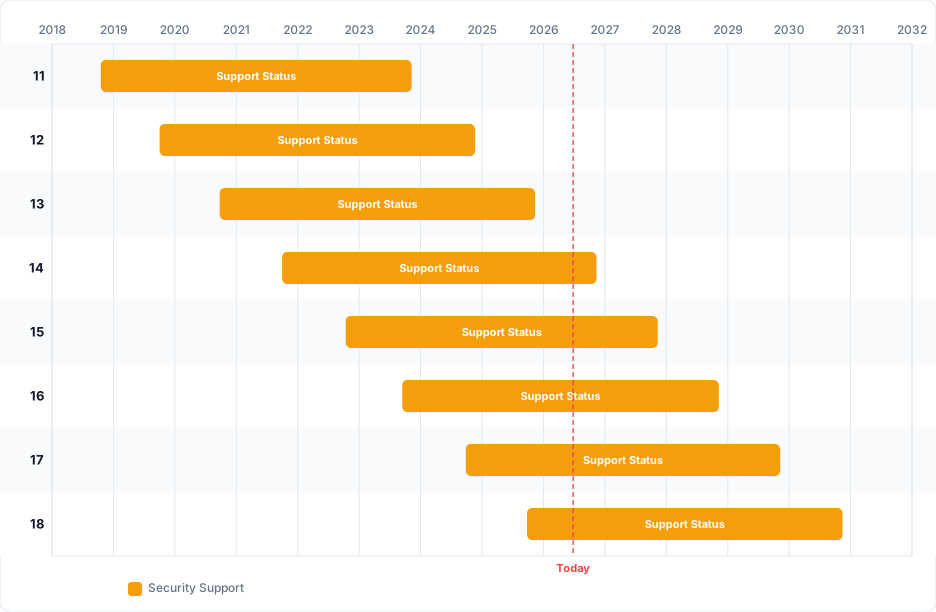
All versions
| Version | Released | Community Support | Latest |
|---|---|---|---|
|
18
|
25 Sep 2025 |
14 Nov 2030
Ends in 4 years, 1 month
|
18.6
11 Aug 2026
|
|
17
|
26 Sep 2024 |
08 Nov 2029
Ends in 3 years, 1 month
|
17.11
10 Aug 2026
|
|
16
|
14 Sep 2023 |
09 Nov 2028
Ends in 2 years, 1 month
|
16.15
10 Aug 2026
|
|
15
|
13 Oct 2022 |
11 Nov 2027
Ends in 1 year, 1 month
|
15.19
10 Aug 2026
|
|
14
|
30 Sep 2021 |
12 Nov 2026
Ends in 1 month, 2 weeks
|
14.24
10 Aug 2026
|
|
13
|
24 Sep 2020 |
13 Nov 2025
Ended 10 months, 2 weeks ago
|
13.23
10 Nov 2025
|
|
12
|
03 Oct 2019 |
21 Nov 2024
Ended 1 year, 10 months ago
|
12.22
18 Nov 2024
|
|
11
|
18 Oct 2018 |
09 Nov 2023
Ended 2 years, 10 months ago
|
11.22
06 Nov 2023
|
About PostgreSQL
First released in 1996 as a successor to the original POSTGRES project, PostgreSQL has grown into one of the most widely deployed relational databases in production, running everything from single-tenant SaaS backends to multi-petabyte analytics platforms. That scale of deployment means PostgreSQL's end of life schedule directly affects a large share of production data infrastructure, and a database is one of the harder pieces of a stack to upgrade quickly once its version falls behind.
PostgreSQL Lifecycle Explained
The PostgreSQL Global Development Group supports each major version for exactly five years from its initial release date. During that window, minor releases containing bug fixes and security patches ship at least once every three months, with out-of-band releases issued sooner if a critical issue can't wait. There's no separate "LTS" tier in PostgreSQL: every major version gets the same five-year window and the same level of support throughout, then goes end of life on the same terms.
A new major version ships roughly once a year, so at any given time there are typically five supported major versions in the field alongside several that have already gone end of life. Once a version hits its five-year anniversary, the development group ships one final minor release containing any outstanding fixes, and after that the version receives nothing further, security patches included. Major version upgrades also require a dump and reload or the use of pg_upgrade, since the on-disk format changes between major versions, which is part of why organizations tend to fall behind PostgreSQL's schedule more easily than with software that supports simpler in-place updates.
Frequently Asked Questions
Is PostgreSQL still supported?
Yes, PostgreSQL as a project is actively developed and supported, with a new major version released about once a year. What goes end of life on a rolling schedule are individual major versions, not PostgreSQL itself.
Is PostgreSQL 12 end of life?
Yes. PostgreSQL 12 reached end of life in November 2024 after its standard five-year support window closed, and it no longer receives any community security patches or bug fixes.
Is PostgreSQL 14 end of life?
Not yet, but it's close. PostgreSQL 14 was released on September 30, 2021, which puts its five-year end of life date at November 12, 2026. Teams still running it should already be planning their upgrade.
How long will PostgreSQL 17 be supported?
PostgreSQL 17 follows the same five-year policy as every other version, so it will remain under community support until roughly five years after its initial release, with an exact end of life date confirmed as that anniversary approaches.