Python End of Life - Dates and Lifecycle
Python is a widely-used general-purpose programming language known for its readability, extensive standard library, and dominance in data science, machine learning, automation, and web backends.
Last updated 8 August 2026
17
Versions tracked
12
At EOL
5
Supported
All versions
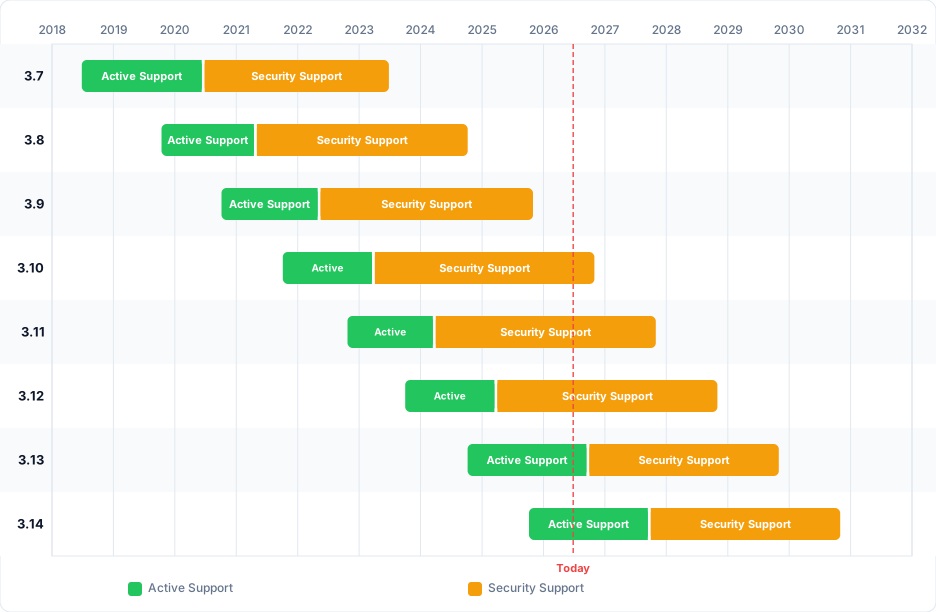
| Version | Released | Active Support | Security Support | Latest |
|---|---|---|---|---|
|
3.14
|
07 Oct 2025 |
01 Oct 2027
Ends in 1 year
|
31 Oct 2030
Ends in 4 years, 1 month
|
3.14.7
05 Aug 2026
|
|
3.13
|
07 Oct 2024 |
01 Oct 2026
Ends in 5 days
|
31 Oct 2029
Ends in 3 years, 1 month
|
3.13.15
05 Aug 2026
|
|
3.12
|
02 Oct 2023 |
02 Apr 2025
Ended 1 year, 5 months ago
|
31 Oct 2028
Ends in 2 years, 1 month
|
3.12.14
12 Aug 2026
|
|
3.11
|
24 Oct 2022 |
01 Apr 2024
Ended 2 years, 5 months ago
|
31 Oct 2027
Ends in 1 year, 1 month
|
3.11.16
13 Aug 2026
|
|
3.10
|
04 Oct 2021 |
05 Apr 2023
Ended 3 years, 5 months ago
|
31 Oct 2026
Ends in 1 month
|
3.10.21
13 Aug 2026
|
|
3.9
|
05 Oct 2020 |
17 May 2022
Ended 4 years, 4 months ago
|
31 Oct 2025
Ended 11 months ago
|
3.9.25
31 Oct 2025
|
|
3.8
|
14 Oct 2019 |
03 May 2021
Ended 5 years, 4 months ago
|
07 Oct 2024
Ended 1 year, 11 months ago
|
3.8.20
06 Sep 2024
|
|
3.7
|
27 Jun 2018 |
27 Jun 2020
Ended 6 years, 3 months ago
|
27 Jun 2023
Ended 3 years, 3 months ago
|
3.7.17
05 Jun 2023
|
About Python
First released in 1991, Python has grown from a scripting language into one of the most deployed languages in production infrastructure worldwide, running everything from web backends and data pipelines to machine learning systems and automation scripts. That scale of deployment means Python's end of life schedule directly affects a huge number of production systems, and it's easy for a version to slip past its support window unnoticed since the code keeps running exactly as before.
Python Lifecycle Explained
The Python Software Foundation gives each release a five year lifecycle, defined in PEP 602. For versions 3.9 through 3.12, that's roughly 18 months of full bugfix support followed by about three and a half years of security only support. Starting with Python 3.13, the full bugfix phase was extended to two years, followed by three years of security only support, keeping the total at five years. Once a version reaches the end of that five year window, the Python core team stops releasing any further updates for it, security fixes included, for good.
A new feature version ships roughly every twelve months, so at any given time there are typically four or five versions somewhere in their support window, spanning full support, security only support, and versions that have already gone end of life. Python 2.7 is the clearest historical example: it stayed supported for over a decade before finally reaching end of life on January 1, 2020, and versions like 3.8 have since followed the newer, shorter five year cycle.
Frequently Asked Questions
What is EOL in Python?
EOL, or end of life, is the date after which the Python Software Foundation stops releasing any updates for a version, including security patches. Once a version is EOL, any vulnerability discovered in it afterward remains permanently unpatched by the core Python team.
What are the currently supported Python versions?
Supported versions change as new releases ship and old ones age out, so the exact list shifts year to year. Check the version pages on this site for the current status and end of life date of each Python release.
How long does a Python version stay supported?
Each version gets five years of total support under PEP 602: roughly 18 months to two years of full bugfix support, followed by three to three and a half years of security only support, depending on the version. After that, the version is retired for good.
Is it safe to keep using a Python version once it's out of full bugfix support but still in security support?
It's still officially supported, but with narrower guarantees. Security only support means critical vulnerabilities get patched, but bug fixes, performance improvements, and compatibility updates for newer libraries stop. Many teams treat the start of security only support as the point to begin planning an upgrade rather than waiting for the actual end of life date.