
Ruby End of Life - Dates and Lifecycle
Ruby is a dynamic, open-source programming language known for its elegant syntax and the Ruby on Rails web framework, released annually on Christmas Day.
Last updated 8 August 2026
15
Versions tracked
12
At EOL
3
Supported
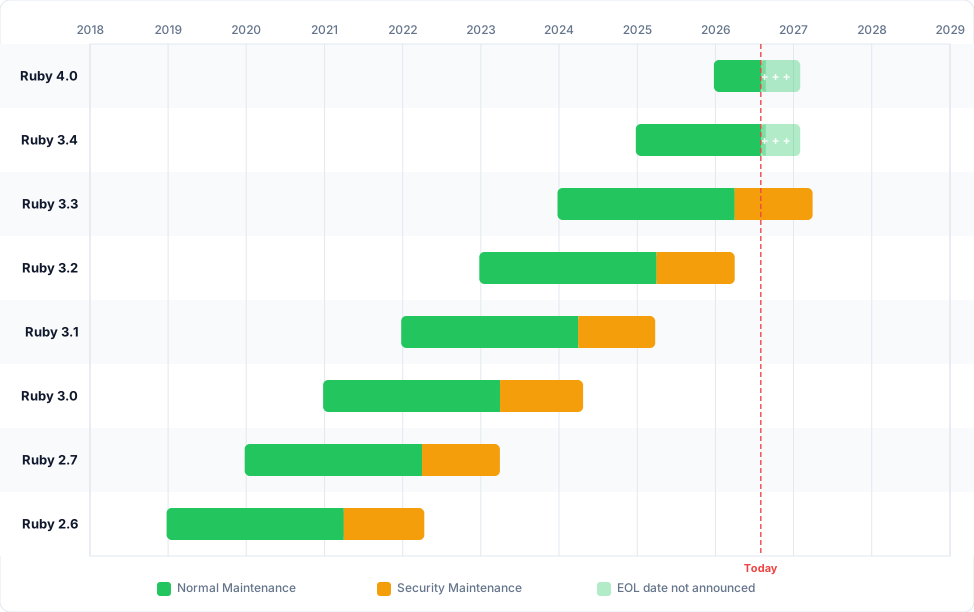
All versions
| Version | Released | Normal Maintenance | Security Maintenance | Latest |
|---|---|---|---|---|
|
4.0
|
25 Dec 2025 |
Active
|
Active
|
4.0.7
14 Sep 2026
|
|
3.4
|
25 Dec 2024 |
Active
|
Active
|
3.4.10
30 Jun 2026
|
|
3.3
|
25 Dec 2023 |
01 Apr 2026
Ended 5 months, 2 weeks ago
|
31 Mar 2027
Ends in 6 months, 2 weeks
|
3.3.12
16 Jul 2026
|
|
3.2
|
25 Dec 2022 |
01 Apr 2025
Ended 1 year, 5 months ago
|
01 Apr 2026
Ended 5 months, 2 weeks ago
|
3.2.11
27 Mar 2026
|
|
3.1
|
25 Dec 2021 |
01 Apr 2024
Ended 2 years, 5 months ago
|
26 Mar 2025
Ended 1 year, 5 months ago
|
3.1.7
26 Mar 2025
|
|
3.0
|
25 Dec 2020 |
01 Apr 2023
Ended 3 years, 5 months ago
|
23 Apr 2024
Ended 2 years, 4 months ago
|
3.0.7
23 Apr 2024
|
|
2.7
|
25 Dec 2019 |
01 Apr 2022
Ended 4 years, 5 months ago
|
31 Mar 2023
Ended 3 years, 5 months ago
|
2.7.8
30 Mar 2023
|
|
2.6
|
25 Dec 2018 |
01 Apr 2021
Ended 5 years, 5 months ago
|
12 Apr 2022
Ended 4 years, 5 months ago
|
2.6.10
12 Apr 2022
|
About Ruby
Ruby has a distinctive release tradition: a new version ships every year on December 25th, a practice the community has followed for over a decade. It's a dynamic, open-source programming language known for its readable syntax and developer-friendly design.
Ruby Lifecycle Explained
Each Ruby version moves through two support phases before reaching end of life. Normal maintenance, roughly the first two years, includes both bug fixes and security patches. Security maintenance, roughly the year after that, narrows down to security fixes only. Combined, that gives each version about three years of support, typically ending on March 31st a few years after its Christmas release.
Ruby 4.0, released in December 2025, is the first major version bump since Ruby 3.0 in 2020, a signal of continued active development rather than the language winding down. Ruby 3.4 and 4.0 are both currently in normal maintenance, with no end of life date set yet.
Frequently Asked Questions
What does Ruby EOL mean?
It means Ruby's core team no longer provides any fixes for that version, security patches included. Once a version passes its security maintenance window, any newly discovered vulnerability stays unpatched unless you're using a third-party extended support provider.
Is Ruby 2.7 EOL?
Yes. Ruby 2.7 completed its security maintenance phase and reached end of life on March 31, 2023.
How dangerous is it to run an EOL Ruby version?
It carries real, unmanaged risk. Ruby receives regular security patches during its supported phases, and once a version is EOL, any vulnerability discovered afterward has no official fix, leaving applications exposed indefinitely unless the team migrates or pays for extended support.
Why is Ruby not as popular as it used to be?
Ruby's relative share of new projects has declined as other languages have grown, but it remains widely used in production, particularly through Ruby on Rails, and continues to see active core development, including the recent jump to Ruby 4.0. Popularity trends and active maintenance are separate questions, and Ruby holds up on the latter.
Is Ruby on Rails still relevant in 2026?
Yes, Rails remains widely used and actively developed. Rails has its own separate version support schedule distinct from Ruby the language, worth checking independently if you're assessing a specific Rails application's risk.