
WildFly End of Life - Dates and Lifecycle
WildFly is a free, open-source Java application server developed by Red Hat and the WildFly community, implementing the Jakarta EE specification for building and deploying enterprise Java applications.
Last updated 22 October 2026
9
Versions tracked
8
At EOL
1
Supported
All versions
| Version | Released | Security Support | Latest |
|---|---|---|---|
|
42
|
22 Oct 2026 |
Active
|
— |
|
41
|
16 Jul 2026 |
22 Oct 2026
Ended 1 day ago
|
41.0.1
26 Aug 2026
|
|
40
|
21 May 2026 |
16 Jul 2026
Ended 3 months, 1 week ago
|
40.0.1
22 Jun 2026
|
|
39
|
16 Jan 2026 |
21 May 2026
Ended 5 months ago
|
39.0.1
12 Feb 2026
|
|
34
|
17 Oct 2024 |
16 Jan 2026
Ended 9 months, 1 week ago
|
34.0.1
22 Nov 2024
|
|
33
|
23 Jul 2024 |
17 Oct 2024
Ended 2 years ago
|
33.0.2
17 Sep 2024
|
|
30
|
18 Oct 2023 |
23 Jul 2024
Ended 2 years, 3 months ago
|
— |
|
27
|
09 Nov 2022 |
18 Oct 2023
Ended 3 years ago
|
— |
About WildFly
WildFly is the open-source upstream project that Red Hat's commercial JBoss EAP product is built from, and the WildFly team has been unusually direct about how its release policy actually works. It's a free, open-source Java application server implementing the Jakarta EE specification.
WildFly Lifecycle Explained
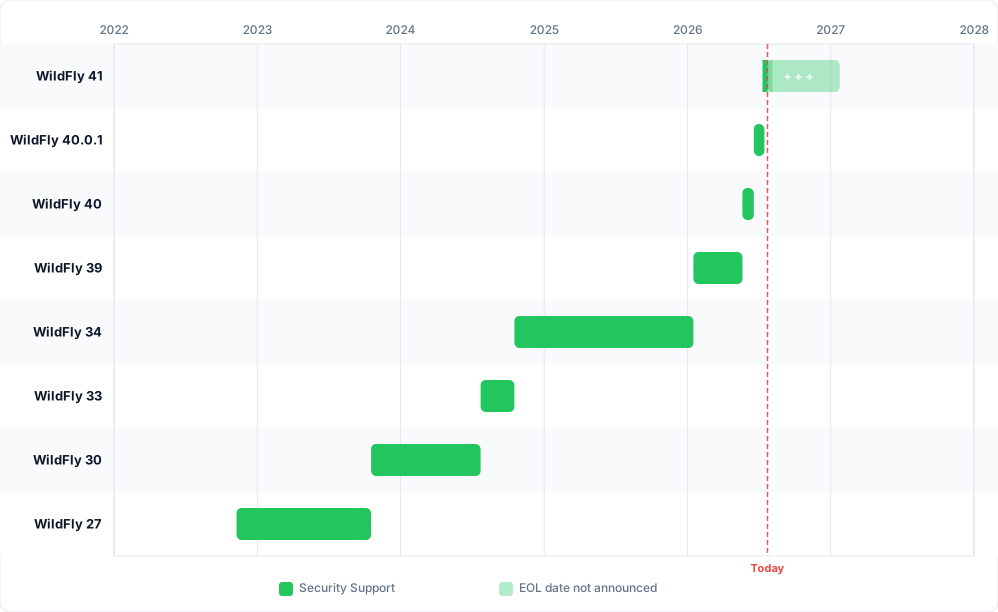
WildFly's release cycle works differently from most software covered on this site, and the WildFly team has stated their policy directly: "the WildFly project generally doesn't continue to produce bug-fix releases for older versions once a new major or minor release is out." In practice, a new major version ships roughly every quarter, typically aiming for a January, April, July, and October cadence, though releases sometimes slip by several weeks. Each major version usually gets exactly one bug-fix patch release about a month later, and once the next quarterly major version ships, that's it, no further patches, security fixes included.
The one notable exception in WildFly's history illustrates this policy well. In January 2023, roughly two months after WildFly 27 had already superseded WildFly 26, the project issued WildFly 26.1.3 specifically to backport a fix for a critical Apache CXF vulnerability. They explained they were making an exception because the migration to WildFly 27 and its Jakarta EE 10 support was taking users longer than usual, not because their standard policy had changed. Outside of situations like that, once a version is superseded, it stays superseded.
WildFly also ships a WildFly Preview distribution alongside the standard release, which gets newer or experimental Jakarta EE features before they're promoted into the standard distribution, and, starting around WildFly 40, a WildFly EE 10 distribution for users who want EE 10 support after the standard distribution has moved on to a newer EE version.
Frequently Asked Questions
Does WildFly backport security fixes to old versions?
Generally, no. The one documented exception was a critical Apache CXF CVE backported to WildFly 26 in 2023, well after it had already been superseded, which the team explicitly described as a rare departure from their usual approach.
What is WildFly Preview?
WildFly Preview is a separate distribution that includes newer or experimental Jakarta EE features before they're stable enough for the standard WildFly distribution. It follows the same quarterly release and end of life pattern as standard WildFly.