
Apache Hive End of Life - Dates and Lifecycle
Apache Hive is a data warehouse system built on Hadoop for querying and managing large datasets with SQL, now in its actively developed 4.x line after the 1.x, 2.x, and 3.x lines reached end of life.
Last updated 7 September 2026
12
Versions tracked
9
At EOL
3
Supported
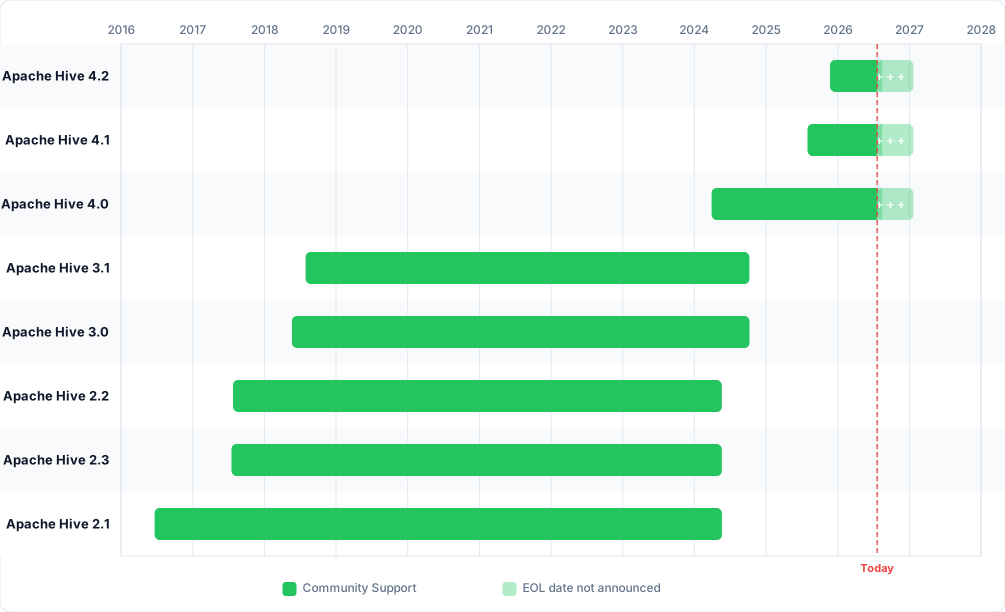
All versions
| Version | Released | Community Support | Latest |
|---|---|---|---|
|
4.2
|
23 Nov 2025 |
Active
|
4.2.1
13 Aug 2026
|
|
4.1
|
31 Jul 2025 |
Active
|
4.1.0
31 Jul 2025
|
|
4.0
|
29 Mar 2024 |
Active
|
4.0.1
02 Oct 2024
|
|
3.1
|
30 Jul 2018 |
08 Oct 2024
Ended 2 years ago
|
3.1.3
08 Apr 2022
|
|
3.0
|
21 May 2018 |
08 Oct 2024
Ended 2 years ago
|
3.0.0
21 May 2018
|
|
2.2
|
25 Jul 2017 |
20 May 2024
Ended 2 years, 5 months ago
|
2.2.0
25 Jul 2017
|
|
2.3
|
17 Jul 2017 |
20 May 2024
Ended 2 years, 5 months ago
|
2.3.10
09 May 2024
|
|
2.1
|
20 Jun 2016 |
20 May 2024
Ended 2 years, 5 months ago
|
2.1.1
08 Dec 2016
|
About Apache Hive
Apache Hive has been a core part of the Hadoop ecosystem since the early 2010s, and while newer engines have taken some of its market share, it's still widely deployed in production data platforms today. It's a data warehouse system built on top of Hadoop, letting teams query and manage large datasets using SQL instead of writing raw MapReduce or Spark jobs directly.
Apache Hive Lifecycle Explained
Hive's end of life process works differently from most software on this site, and that difference matters more than the dates themselves. Vendor-backed products like RHEL or Ubuntu announce a support window in advance, so you know the end of life date before it arrives. Hive, as a purely community-run Apache project, does the opposite: there's no advance schedule at all. A release line just keeps getting occasional patches for as long as contributors are willing to maintain it, and end of life is only made official later, through a formal community vote, once it's clear no one is doing that work anymore.
In practice, this means the real end of a Hive line and its official end of life declaration can be years apart. Hive 1.x's last actual release shipped in April 2017, but the Hive community didn't formally vote to declare the line end of life until April 2024, seven years later. Hive 3.x tells a similar story: its last release was April 2022, with the formal EOL vote not landing until October 2024. Hive 2.x is the exception, its final release and EOL vote landed only 11 days apart. The practical takeaway: if a Hive line hasn't had a release in a long time, treat it as unsupported in practice well before any official EOL announcement confirms it.
Hive 4.x is the current line, with releases still shipping regularly, most recently 4.2.0 in November 2025. There's no scheduled end date for it, the same way there wasn't one for 1.x, 2.x, or 3.x while they were still active; an EOL date only gets attached retroactively once the line is confirmed abandoned.
Frequently Asked Questions
Which Apache Hive versions are end of life?
The 1.x, 2.x, and 3.x lines are all formally end of life: 1.x since April 2024, 2.x since May 2024, and 3.x since October 2024. Hive 4.x is the current, actively maintained line.
What does end of life actually mean for a Hive deployment?
It means the Hive community will not release any further patches, security fixes included, for that line. Unlike vendor products, this status is usually declared after a line has already gone quiet for a long stretch, so many deployments are effectively unsupported well before the official EOL vote confirms it.
Is it safe to keep running an EOL Hive version in production?
No. Once a line is EOL, any vulnerability discovered in it afterward has no official patch path from the Apache Hive project. For compliance frameworks like PCI DSS or SOC 2 that expect timely security patching, an EOL Hive deployment is difficult to justify without a documented compensating control, such as a vendor-maintained distribution that backports fixes independently.
What are my options if I'm running an EOL Hive version?
The most direct path is upgrading to Hive 4.x, which is a significant jump given the metastore and architecture changes involved, so it's worth treating as a real migration project rather than a quick version bump. Some teams instead choose to replace Hive with a different query engine as part of a broader platform modernization. If neither is immediately feasible, Hadoop-ecosystem vendors and managed platforms sometimes maintain their own patched Hive builds independent of the Apache project's official release line, which can serve as a stopgap while a longer-term plan is worked out.