
Ubuntu End of Life - Dates and Lifecycle
Ubuntu is a free, Debian-based Linux distribution from Canonical, one of the most widely deployed operating systems for servers, cloud instances, and desktops.
Last updated 6 September 2026
44
Versions tracked
41
At EOL
3
Supported
All versions
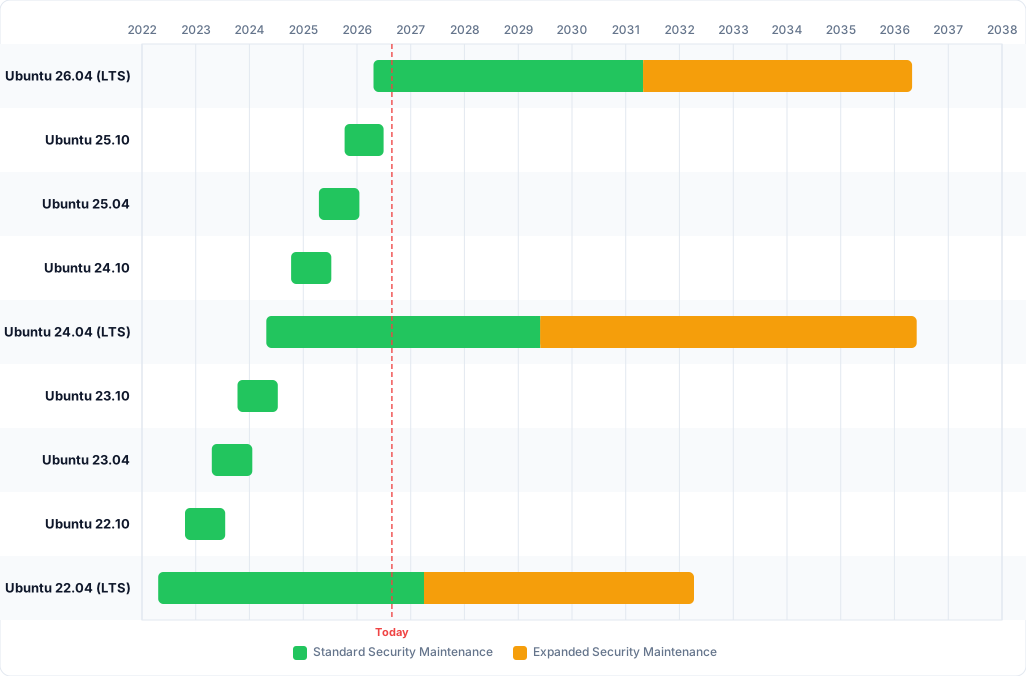
| Version | Released | Standard Security Maintenance | Expanded Security Maintenance | Latest |
|---|---|---|---|---|
|
26.04
LTS
|
23 Apr 2026 |
31 May 2031
Ends in 4 years, 7 months
|
30 Apr 2036
Ends in 9 years, 6 months
|
26.04.1
31 Aug 2026
|
|
25.10
|
09 Oct 2025 |
01 Jul 2026
Ended 3 months, 1 week ago
|
— |
25.10
09 Oct 2025
|
|
25.04
|
17 Apr 2025 |
17 Jan 2026
Ended 8 months, 3 weeks ago
|
— |
25.04
17 Apr 2025
|
|
24.10
|
10 Oct 2024 |
10 Jul 2025
Ended 1 year, 3 months ago
|
— |
24.10
10 Oct 2024
|
|
24.04
LTS
|
25 Apr 2024 |
31 May 2029
Ends in 2 years, 7 months
|
31 May 2036
Ends in 9 years, 7 months
|
24.04.5
10 Sep 2026
|
|
23.10
|
12 Oct 2023 |
12 Jul 2024
Ended 2 years, 3 months ago
|
— |
23.10
12 Oct 2023
|
|
23.04
|
20 Apr 2023 |
20 Jan 2024
Ended 2 years, 8 months ago
|
— |
23.04
20 Apr 2023
|
|
22.10
|
20 Oct 2022 |
20 Jul 2023
Ended 3 years, 2 months ago
|
— |
22.10
20 Oct 2022
|
About Ubuntu
Ubuntu's version numbers tell you exactly when a release shipped: the format is YY.MM, so 22.04 means April 2022. Canonical ships a new release every six months, but only the April release in even-numbered years is designated Long Term Support (LTS), and LTS is what almost all production deployments should be running. The gap between an LTS and an ordinary interim release is large enough that picking the wrong one has real consequences for how soon you'll need to upgrade again.
Ubuntu Lifecycle Explained
Interim releases, the ones that land in odd years or in October, get nine months of updates before they're retired, they're built for people who want the newest packages and are willing to upgrade twice a year. LTS releases get five years of standard support covering the core system, and Canonical also offers Expanded Security Maintenance (ESM) through an Ubuntu Pro subscription that extends coverage another five years, bringing total support to ten years. A further Legacy add-on can stretch that to fifteen years for organizations that need it. Free personal use of Ubuntu Pro's ESM tier is available on a small number of machines, which covers individual users, though enterprise deployments at scale need a paid subscription.
Because of this tiered model, "is Ubuntu X end of life" often has two different honest answers depending on whether you mean standard support or ESM. A release can be past its five-year standard support window and still be receiving security patches for years afterward under ESM, so it's worth checking which tier actually applies to your systems before assuming a version is fully unsupported.
One practical wrinkle: Ubuntu upgrades between LTS releases are sequential, not direct. You can't jump straight from 16.04 to 22.04, you have to step through 18.04 and 20.04 first, which is worth planning for well ahead of an EOL deadline rather than discovering it during a rushed migration.
Frequently Asked Questions
When is Ubuntu 22.04 end of life?
Ubuntu 22.04 LTS (Jammy Jellyfish)'s standard support ends in May 2027. With an Ubuntu Pro subscription, ESM coverage extends that to April 2032.
When is Ubuntu 24.04 end of life?
Ubuntu 24.04 LTS (Noble Numbat)'s standard support runs through April 2029, with Ubuntu Pro ESM able to extend coverage to April 2034.
Is Ubuntu 16.04 still supported?
Not through Canonical's standard channels or ESM. Ubuntu 16.04's standard support ended in April 2021, and its five-year ESM extension ran out in April 2026. At this point, continuing to run it means relying on a third-party extended support provider or migrating.
How do I upgrade Ubuntu after end of life?
Since Ubuntu upgrades are sequential, you'll typically need to move through each intervening LTS release rather than jumping straight to the latest one, for example, from 16.04 to 18.04, then to 20.04, and onward. For systems too far behind or too critical to take offline during that process, extended security maintenance buys time to plan the upgrade properly rather than rushing it.