
CentOS Stream End of Life - Dates and Lifecycle
CentOS Stream is a continuously updated Linux distribution that tracks just ahead of Red Hat Enterprise Linux development, serving as the successor to the discontinued CentOS Linux.
Last updated 6 September 2026
3
Versions tracked
1
At EOL
2
Supported
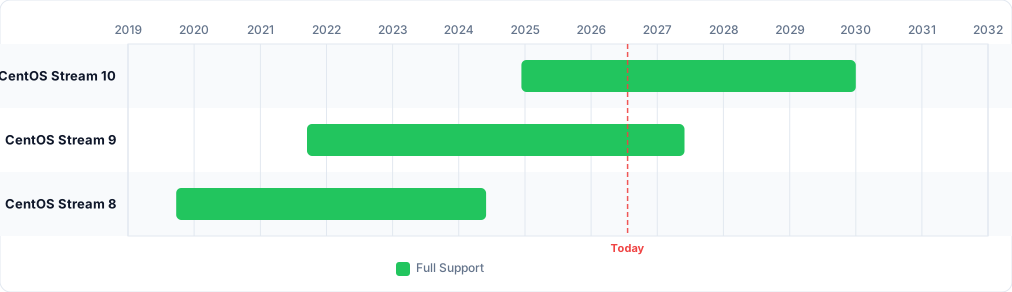
All versions
| Version | Released | Full Support | Latest |
|---|---|---|---|
|
10
|
12 Dec 2024 |
31 May 2030
Ends in 3 years, 7 months
|
— |
|
9
|
15 Sep 2021 |
31 May 2027
Ends in 7 months, 2 weeks
|
— |
|
8
|
24 Sep 2019 |
31 May 2024
Ended 2 years, 4 months ago
|
— |
About CentOS Stream
CentOS Stream is a different product from CentOS Linux, not just a newer version of it. Where CentOS Linux was a fixed rebuild of an already-released RHEL version, CentOS Stream sits upstream of RHEL, continuously receiving packages planned for RHEL's next minor release before RHEL itself ships them. Since CentOS Linux is now fully discontinued, CentOS Stream is the CentOS Project's only ongoing product, and its support model works differently enough that it's worth understanding on its own terms rather than assuming it follows the old CentOS Linux rules.
CentOS Stream Lifecycle Explained
CentOS Stream has no minor versions and no batched update cycles, packages land as they're ready in a continuous stream rather than in discrete releases. What it does have is major versions, and each one's end of life date is tied directly to its corresponding RHEL release: a CentOS Stream major version reaches end of life when that RHEL version leaves its Full Support phase and moves into Maintenance Support. In practice, that gives each CentOS Stream version roughly five years of life, notably shorter than CentOS Linux's old ten-year run, since CentOS Stream only covers the portion of the RHEL lifecycle where active development is still happening upstream.
CentOS Stream 9 is scheduled to reach end of life on May 31, 2027, when RHEL 9 exits Full Support. CentOS Stream 10, released December 12, 2024, is scheduled to reach end of life May 31, 2030, tracking RHEL 10's Full Support window. CentOS Stream 8 has already reached its end, archived as of May 31, 2024, once RHEL 8 moved into its own maintenance phase.
Because of this shorter, RHEL-tied lifecycle, organizations that need the full ten-year support horizon CentOS Linux used to offer typically look at RHEL itself, or a RHEL-compatible downstream rebuild, rather than CentOS Stream. CentOS Stream is a better fit for teams that want early visibility into upcoming RHEL changes and are comfortable with a shorter, rolling support window than for teams that just want a long-lived, stable production base, which was CentOS Linux's original role.
Frequently Asked Questions
When does CentOS Stream reach end of life?
It depends on the major version, since each one's end date is tied to when its corresponding RHEL release exits Full Support. CentOS Stream 9 is scheduled to end on May 31, 2027, and CentOS Stream 10 is scheduled to end May 31, 2030, following RHEL 10's own timeline.
What are the risks of running an end of life CentOS Stream version?
The same as any unsupported operating system: no further security patches, meaning any vulnerability discovered afterward stays open indefinitely. Since CentOS Stream is often used in development and testing pipelines that feed into production RHEL deployments, an EOL Stream version can also introduce compatibility drift with the RHEL version it's supposed to be tracking.
What are my options if I'm running an EOL CentOS Stream version?
Upgrade to the current CentOS Stream major version, since Stream doesn't offer extended support options the way CentOS Linux and RHEL do. If long-term stability matters more than tracking upstream RHEL development, moving to RHEL itself or a RHEL-compatible rebuild like Rocky Linux or AlmaLinux is generally the better fit going forward.