
FastAPI End of Life - Dates and Lifecycle
FastAPI is a high-performance Python web framework for building APIs, using type hints and Pydantic for validation, built on top of Starlette.
Last updated 21 October 2026
31
Versions tracked
29
At EOL
2
Supported
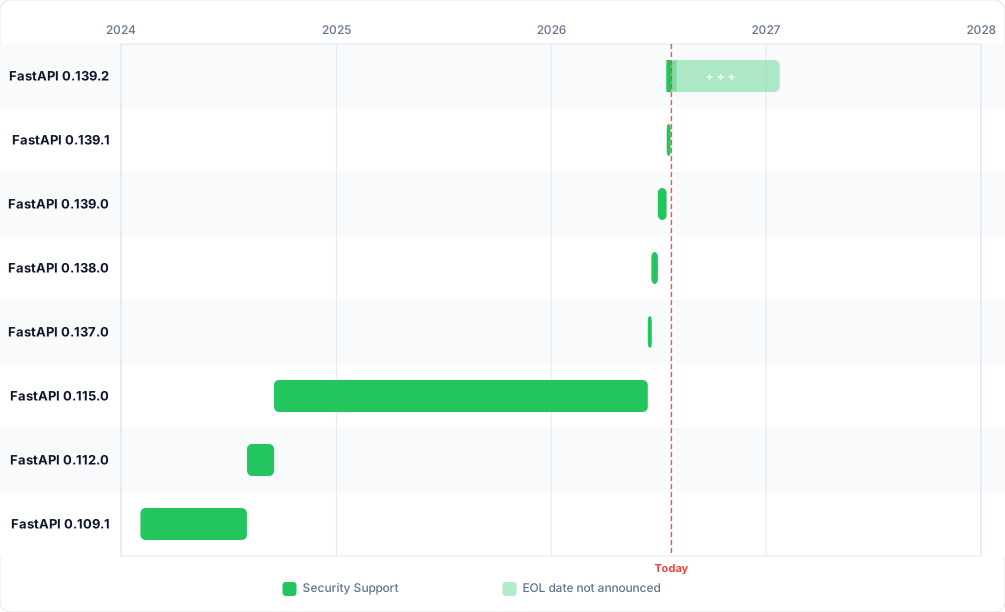
All versions
| Version | Released | Security Support | Latest |
|---|---|---|---|
|
0.156.5
|
21 Oct 2026 |
21 Oct 2026
Ended 2 days ago
|
— |
|
0.156.8
|
21 Oct 2026 |
Active
|
— |
|
0.156.7
|
21 Oct 2026 |
21 Oct 2026
Ended 2 days ago
|
— |
|
0.156.6
|
21 Oct 2026 |
21 Oct 2026
Ended 2 days ago
|
— |
|
0.151.0
|
20 Oct 2026 |
21 Oct 2026
Ended 2 days ago
|
— |
|
0.147.0
|
19 Oct 2026 |
20 Oct 2026
Ended 3 days ago
|
— |
|
0.143.4
|
18 Oct 2026 |
18 Oct 2026
Ended 5 days ago
|
— |
|
0.143.5
|
18 Oct 2026 |
18 Oct 2026
Ended 5 days ago
|
— |
About FastAPI
FastAPI has become one of the most widely adopted Python web frameworks since its creation in December 2018, driven largely by its automatic OpenAPI documentation and heavy use of Python type hints for validation. It's built on top of Starlette for the underlying ASGI handling.
FastAPI Lifecycle Explained
FastAPI has no formal end of life policy, and its own official documentation doesn't use that language at all, there's no announced support window, deprecation schedule, or security-only phase. Instead, FastAPI follows an explicit Semantic Versioning convention even while staying below version 1.0.0: PATCH releases (the last number, as in 0.112.3) are always bug fixes and non-breaking changes, while MINOR releases (the middle number, as in 0.112.0) can include breaking changes. FastAPI's own docs recommend pinning to a MINOR version range, such as fastapi>=0.112.0,<0.113.0, to get safe patch updates automatically while controlling when you take on breaking changes.
Notably, FastAPI explicitly advises against pinning Starlette separately, each FastAPI version is built against a specific compatible Starlette release, and letting FastAPI manage that dependency avoids version mismatches. This matters given Starlette's own release pace: Starlette reached its first stable 1.0.0 release in March 2026, while FastAPI itself, after roughly seven years of development, remains on 0.x versioning with no announced timeline for a 1.0 release.
Real security fixes do happen periodically, called out explicitly as "Security fixes" in the release notes for versions like 0.65.1, 0.65.2, and 0.109.1. As with Starlette, there's no guarantee these get backported to older MINOR lines, staying current within your pinned MINOR range is the only way to reliably receive them.
Frequently Asked Questions
Is FastAPI end of life?
No, and the framework doesn't use end of life language at all. FastAPI is actively developed with releases shipping multiple times a month, and its own documentation frames version management purely around semantic versioning conventions rather than a support lifecycle.
Does FastAPI follow semantic versioning?
Yes, officially, even below version 1.0.0. FastAPI's own documentation states that PATCH version changes are always bug fixes and non-breaking, while MINOR version changes can include breaking changes and new features. This is an explicit commitment, not just a convention observed after the fact.
Is it safe to upgrade FastAPI automatically?
Patch updates within a pinned MINOR version, for example anything from 0.112.0 up to but not including 0.113.0, should be safe by FastAPI's own versioning policy. Automatically upgrading across MINOR versions is riskier, since those can include breaking changes, and should go through your test suite first.
Why is FastAPI still on version 0.x?
FastAPI's own docs explain that staying below 1.0.0 reflects that any release could still include breaking changes, consistent with Semantic Versioning rules. This is despite roughly seven years of active development and widespread production use, and even though Starlette, the ASGI toolkit FastAPI is built on, reached its own 1.0.0 in March 2026.