
React End of Life - Dates and Lifecycle
React is a JavaScript library for building user interfaces, maintained by Meta, and the foundation many frameworks including Next.js are built on.
Last updated 8 August 2026
5
Versions tracked
0
At EOL
5
Supported
All versions
| Version | Released | Active Support | Security Support | Latest |
|---|---|---|---|---|
|
19
|
05 Dec 2024 |
Active
|
Active
|
19.3.0
09 Sep 2026
|
|
18
|
29 Mar 2022 |
05 Dec 2024
Ended 1 year, 9 months ago
|
Active
|
18.3.1
26 Apr 2024
|
|
17
|
20 Oct 2020 |
29 Mar 2022
Ended 4 years, 6 months ago
|
Active
|
17.0.2
22 Mar 2021
|
|
16
|
26 Sep 2017 |
20 Oct 2020
Ended 5 years, 11 months ago
|
Active
|
16.14.0
14 Oct 2020
|
|
15
|
07 Apr 2016 |
14 Oct 2020
Ended 5 years, 11 months ago
|
Active
|
15.7.0
14 Oct 2020
|
About React
Maintained by Meta and used across a huge share of production web frontends, React has been the default reference point for component-based UI development for over a decade. It's also the foundation many other frameworks are built on, including Next.js, which handles routing and server rendering on top of React itself.
React Lifecycle Explained
React's own team has been explicit that Security Support here works differently than on most software: there's no fixed cutoff date. React's official versioning policy states plainly, "we know our users continue to use old versions of React in production. If we learn of a security vulnerability in React, we release a backported fix for all major versions that are affected by the vulnerability." That commitment isn't limited to the two most recent majors, it applies to any affected version, no matter how old.
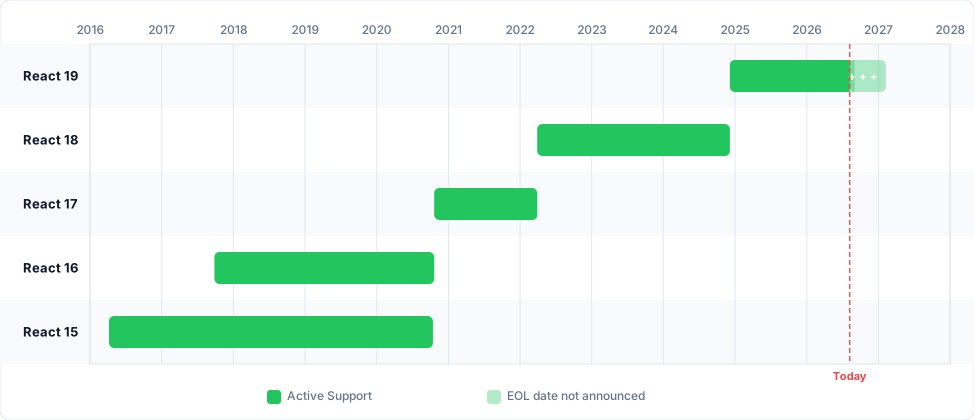
This matters because early aggregated EOL data for React, including on other reference sites, previously implied older majors like React 15 or 16 had a hard security cutoff. A React core team member publicly clarified that this didn't reflect actual policy, and the data has since been corrected to show no fixed Security Support end date for any React version. The exact scope of backporting also has a minor nuance: for the current major version, a critical fix is backported to every minor release, while for older, superseded majors, the fix goes to the latest minor of that major only, not every historical minor within it. What does have a real end date is Active Support, the period during which a major version receives new features, which closes once the next major version ships.
Frequently Asked Questions
Is React 18 end of life?
Not in the way "end of life" usually works. React 18's Active Support (new features) ended when React 19 shipped in December 2024, but per React's own stated policy, a critical security fix would still be backported to React 18 if one were needed.
Is React still relevant in 2026?
Yes, it remains the most widely used frontend JavaScript library, and continues to underpin major frameworks like Next.js, which builds directly on top of it.
Has React 19 been released?
Yes, React 19 was released in December 2024 and is the current major version.
Is React 19 ready for production?
Yes. React 19 ships through React's "Latest" release channel, which is the stable, production-recommended channel. React's Canary and Experimental channels are separate, explicitly not intended for direct production use without a pinned, curated setup.