
Ruby on Rails End of Life - Dates and Lifecycle
Ruby on Rails is a full-stack, server-side web application framework written in Ruby, known for convention-over-configuration and rapid development.
Last updated 8 August 2026
11
Versions tracked
9
At EOL
2
Supported
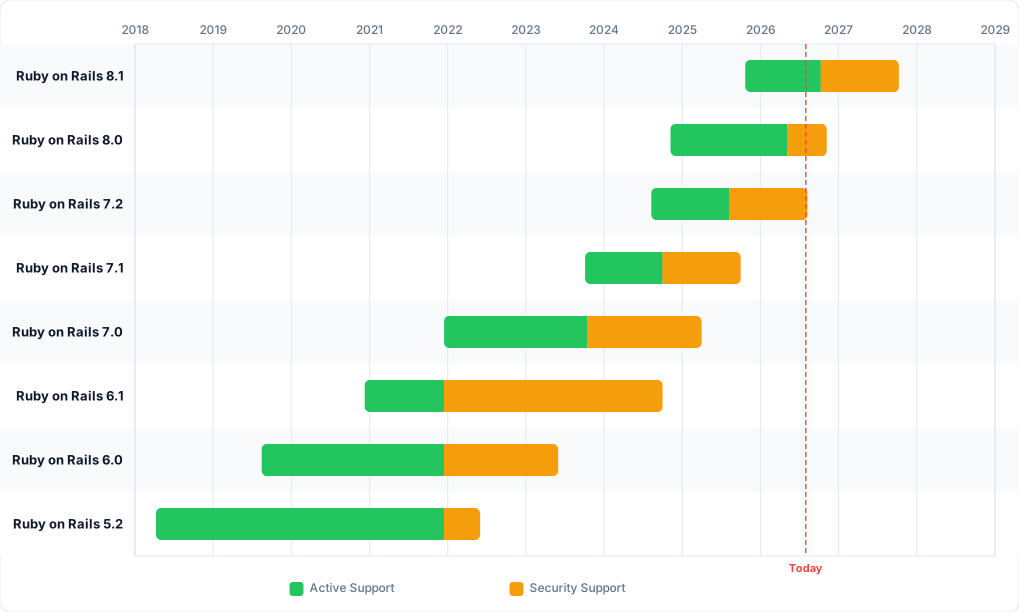
All versions
| Version | Released | Active Support | Security Support | Latest |
|---|---|---|---|---|
|
8.1
|
22 Oct 2025 |
10 Oct 2026
Ends in 3 weeks
|
10 Oct 2027
Ends in 1 year
|
8.1.3.1
29 Jul 2026
|
|
8.0
|
07 Nov 2024 |
07 May 2026
Ended 4 months, 2 weeks ago
|
07 Nov 2026
Ends in 1 month, 2 weeks
|
8.0.5.1
29 Jul 2026
|
|
7.2
|
09 Aug 2024 |
09 Aug 2025
Ended 1 year, 1 month ago
|
09 Aug 2026
Ended 1 month, 1 week ago
|
7.2.3.2
29 Jul 2026
|
|
7.1
|
05 Oct 2023 |
01 Oct 2024
Ended 1 year, 11 months ago
|
01 Oct 2025
Ended 11 months, 3 weeks ago
|
7.1.6
28 Oct 2025
|
|
7.0
|
15 Dec 2021 |
15 Oct 2023
Ended 2 years, 11 months ago
|
01 Apr 2025
Ended 1 year, 5 months ago
|
7.0.10
28 Oct 2025
|
|
6.1
|
09 Dec 2020 |
15 Dec 2021
Ended 4 years, 9 months ago
|
01 Oct 2024
Ended 1 year, 11 months ago
|
6.1.7.10
23 Oct 2024
|
|
6.0
|
16 Aug 2019 |
15 Dec 2021
Ended 4 years, 9 months ago
|
01 Jun 2023
Ended 3 years, 3 months ago
|
6.0.6.1
17 Jan 2023
|
|
5.2
|
09 Apr 2018 |
15 Dec 2021
Ended 4 years, 9 months ago
|
01 Jun 2022
Ended 4 years, 3 months ago
|
5.2.8.1
12 Jul 2022
|
About Ruby on Rails
Rails' official maintenance policy is unusually precise for an open-source framework, and it's actually enforced: when the release schedule slips, the policy explicitly extends the previous version's support to cover the gap. It's a full-stack, server-side framework written in Ruby, built around convention-over-configuration.
Ruby on Rails Lifecycle Explained
Rails' official maintenance policy is precise: each minor version gets one year of bug fixes (Active Support) and two years of security fixes total from its first release (Security Support), after which it reaches end of life. Rails aims to ship a new version with new features every six months, and if that schedule slips, the policy explicitly extends the previous version's support to cover the gap, which is exactly what happened with Rails 8.0, its Active Support window ran longer than the usual year because 8.1 arrived later than typical.
Frequently Asked Questions
Is Ruby on Rails still used in 2026?
Yes, Rails remains widely used in production and continues active development, with 8.1 as the current release and regular releases maintaining the roughly six-month cadence the project targets.
Is Ruby on Rails 7.2 EOL?
Not yet. Rails 7.2 is past its Active Support window but still within Security Support, which runs until August 2026.
Is Ruby on Rails obsolete?
No. It's an actively maintained framework with a defined, published support policy, and it continues to see new major and minor releases rather than stagnating.
Is Ruby on Rails front end or back end?
Back end. Rails handles server-side logic, routing, and database access, and while it includes view rendering and can integrate with frontend JavaScript frameworks, it isn't a frontend framework itself.