
AlmaLinux End of Life - Dates and Lifecycle
AlmaLinux is a free, open-source, RHEL-compatible Linux distribution created by the AlmaLinux OS Foundation as a community-driven successor to CentOS Linux.
Last updated 8 August 2026
3
Versions tracked
0
At EOL
3
Supported
All versions
| Version | Released | Active Support | Security Support | Latest |
|---|---|---|---|---|
|
10
|
27 May 2025 |
31 May 2030
Ends in 3 years, 7 months
|
31 May 2035
Ends in 8 years, 7 months
|
10.2
26 May 2026
|
|
9
|
26 May 2022 |
31 May 2027
Ends in 7 months, 2 weeks
|
31 May 2032
Ends in 5 years, 7 months
|
9.8
26 May 2026
|
|
8
|
30 Mar 2021 |
31 May 2024
Ended 2 years, 4 months ago
|
31 May 2029
Ends in 2 years, 7 months
|
8.10
28 May 2024
|
About AlmaLinux
AlmaLinux was created in 2021 by CloudLinux and the newly formed AlmaLinux OS Foundation, directly in response to Red Hat's decision to discontinue traditional CentOS Linux. It's a free, open-source, community-governed operating system built to be compatible with Red Hat Enterprise Linux. In July 2023, the project shifted its stated goal from being a strict downstream rebuild of RHEL to maintaining ABI (Application Binary Interface) compatibility instead, meaning software, drivers, and kernel modules built for RHEL are expected to work identically on AlmaLinux, without AlmaLinux committing to being a literal bug-for-bug clone.
AlmaLinux Lifecycle Explained
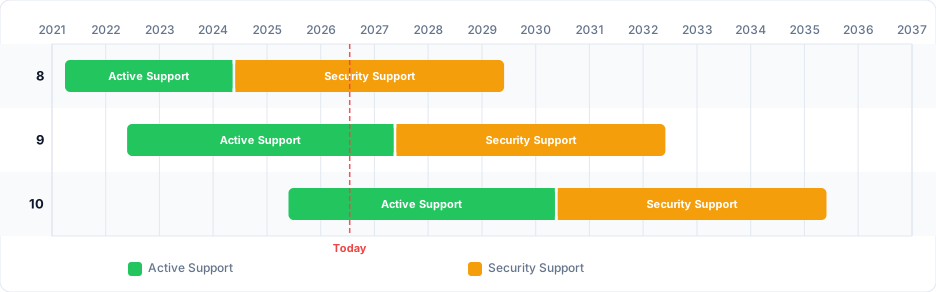
AlmaLinux aims for ABI compatibility with RHEL rather than a strict 1:1 rebuild, and its support timeline follows RHEL's own phases just as closely. Each major version gets Active Support, roughly the first three to five years, with regular updates, followed by Security Support, extending total coverage to 10 years from release. AlmaLinux 8's Active Support closed in May 2024, but it remains in Security Support through May 2029. AlmaLinux 9 is still in Active Support until May 2027, with Security Support running to May 2032. AlmaLinux 10, the newest major version, follows the same shape: Active Support to May 2030, Security Support to May 2035.
Within each major version, only the current minor release stays maintained, the same pattern used by Oracle Linux and RHEL itself: once a new minor ships, the previous one stops receiving updates, even though the major version as a whole remains supported. AlmaLinux 8.10, for example, is the final minor of the 8.x line and the one still receiving fixes, while 8.9 and earlier are no longer updated on their own.
Frequently Asked Questions
Is AlmaLinux 8 EOL?
Not entirely. AlmaLinux 8's Active Support phase ended in May 2024, but it moved into Security Support rather than going fully unsupported, and that phase runs through May 2029. It's past its most actively developed phase, but it isn't end of life yet.
How long will AlmaLinux 9 be supported?
AlmaLinux 9 is in Active Support until May 2027, followed by Security Support through May 2032, for 10 years of total coverage from its 2022 release, matching RHEL 9's own timeline exactly.
What is the latest version of AlmaLinux?
AlmaLinux 10.2 is the latest release, published in May 2026. AlmaLinux 9.8 shipped the same day as the current minor for the still-supported 9.x line.
What is the alternative to AlmaLinux?
The closest alternatives are Rocky Linux, another free RHEL-compatible rebuild born from CentOS's discontinuation, and Oracle Linux, which is also free to use but backed by Oracle with optional paid support tiers. Red Hat Enterprise Linux itself and CentOS Stream are the other two paths in the same ecosystem, though both work differently: RHEL requires a subscription, and CentOS Stream sits upstream of RHEL rather than matching a released version.
Is AlmaLinux free?
Yes. AlmaLinux is entirely free and open source, with no paid tier required for the operating system itself. It's governed by the nonprofit AlmaLinux OS Foundation rather than a single commercial vendor, which is part of what distinguishes it from Oracle Linux's vendor-backed model.