
Oracle Linux End of Life - Dates and Lifecycle
Oracle Linux is a free, open-source Red Hat Enterprise Linux rebuild from Oracle, offering full binary compatibility with RHEL plus Oracle's own Unbreakable Enterprise Kernel.
Last updated 8 August 2026
5
Versions tracked
2
At EOL
3
Supported
All versions
| Version | Released | Basic/Premier Support | Extended Support | Latest |
|---|---|---|---|---|
|
10
|
Jun 2025 |
Jun 2035
Ends in 8 years, 8 months
|
Jun 2038
Ends in 11 years, 8 months
|
10.1
06 Dec 2025
|
|
9
|
06 Jul 2022 |
30 Jun 2032
Ends in 5 years, 8 months
|
30 Jun 2035
Ends in 8 years, 8 months
|
9.8
23 Jun 2026
|
|
8
|
19 Jul 2019 |
31 Jul 2029
Ends in 2 years, 9 months
|
31 Jul 2032
Ends in 5 years, 9 months
|
8.10
28 May 2024
|
|
7
|
23 Jul 2014 |
31 Dec 2024
Ended 1 year, 9 months ago
|
30 Jun 2028
Ends in 1 year, 8 months
|
7.9
08 Oct 2020
|
|
6
|
12 Feb 2011 |
31 Mar 2021
Ended 5 years, 6 months ago
|
31 Dec 2024
Ended 1 year, 9 months ago
|
6.10
02 Jul 2018
|
About Oracle Linux
Oracle Linux is built from RHEL source code and stays 100% binary compatible with it, which is part of why it became a popular option for organizations migrating off CentOS, Oracle even offers a free conversion script for exactly that move. But its support lifecycle isn't identical to RHEL's, and one difference in particular catches people out: Oracle Linux doesn't keep old minor releases supported once a newer one ships. The moment a new point release lands, the previous one is immediately end of life, whereas RHEL keeps supporting older minor versions for longer under its own policy.
Oracle Linux Lifecycle Explained
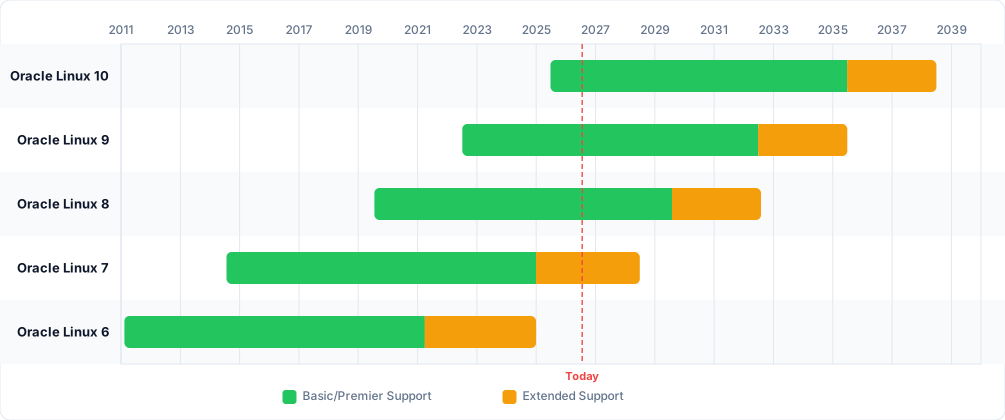
Oracle uses a three-tier support model for each major version. Premier Support covers the first 10 years from release, with full patches, bug fixes, and security updates, plus access to Oracle's zero-downtime Ksplice patching. After that, an optional paid Extended Support add-on covers critical security errata and select high-impact bug fixes for a further, limited number of years. Once Extended Support ends, Sustaining Support is available indefinitely, but it includes no new security fixes at all, just access to whatever was already released.
Within that 10-year Premier Support window, only the current minor release of a major version is actually maintained. If Oracle Linux 8.10 is the latest 8.x release, only 8.10 receives updates, older minors like 8.9 or 8.8 are immediately out of support the moment 8.10 ships, even though the Oracle Linux 8 major version as a whole is still well within its supported life. This is a meaningfully different model from RHEL, where multiple minor releases can remain independently supported for a period through Extended Update Support.
Currently, Oracle Linux 10 (released June 2025, with 10.1 following in December 2025) is the latest major version. Oracle Linux 9 remains in Premier Support, and Oracle Linux 7 has already reached end of life, with support ending December 31, 2024.
Frequently Asked Questions
Is Oracle Linux 8.10 EOL?
No. As the current, final minor release of the Oracle Linux 8 line, 8.10 is the version that's actively maintained, while earlier 8.x minors are already out of support. Oracle Linux 8 as a whole remains in its supported lifecycle.
What OS replaced CentOS?
There's no single official replacement, but three main paths emerged after CentOS Linux was discontinued: Oracle Linux itself, which offers a free migration script for former CentOS users, and community RHEL rebuilds Rocky Linux and AlmaLinux, both built specifically to fill the role CentOS used to play.
What is the latest release of Oracle Linux?
Oracle Linux 10.1, released in December 2025, is the current release as of this writing. It's built on Oracle Linux 10, which first shipped in June 2025.
Is Oracle Linux 10 released?
Yes. Oracle Linux 10 became generally available in June 2025, offering full binary compatibility with RHEL 10 along with Oracle's own Unbreakable Enterprise Kernel as an alternative to the standard Red Hat Compatible Kernel.