
Knockout.js End of Life - Dates and Lifecycle
Knockout.js is a JavaScript library that implements the Model-View-ViewModel (MVVM) pattern with automatic UI updates through observables, used for building dynamic, data-driven web interfaces.
Last updated 7 September 2026
27
Versions tracked
26
At EOL
1
Supported
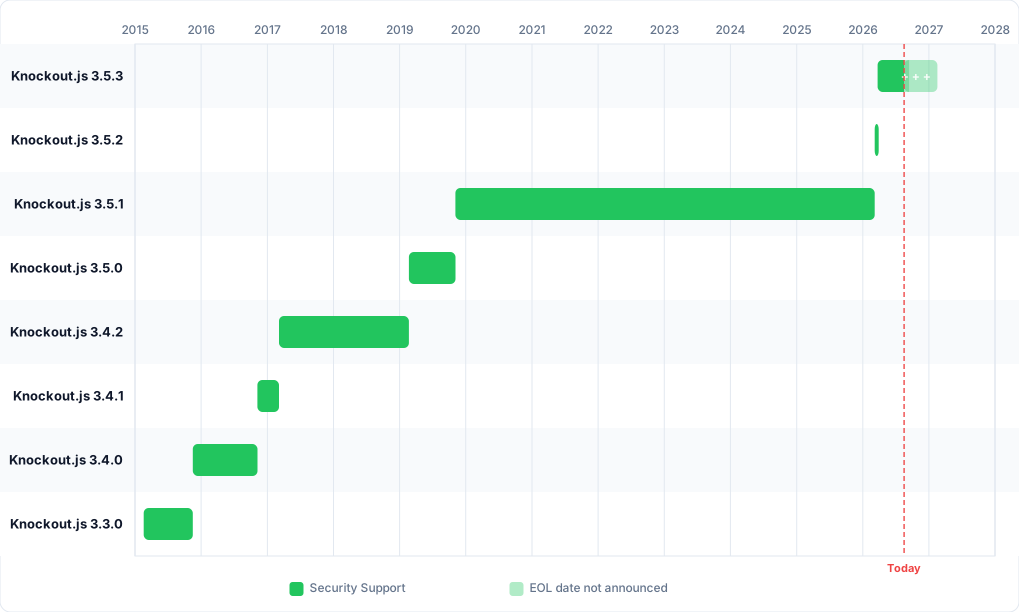
All versions
| Version | Released | Security Support | Latest |
|---|---|---|---|
|
3.5.3
|
24 Mar 2026 |
Active
|
— |
|
3.5.2
|
08 Mar 2026 |
24 Mar 2026
Ended 6 months, 1 week ago
|
— |
|
3.5.1
|
05 Nov 2019 |
08 Mar 2026
Ended 6 months, 3 weeks ago
|
— |
|
3.5.0
|
21 Feb 2019 |
05 Nov 2019
Ended 6 years, 11 months ago
|
— |
|
3.4.2
|
06 Mar 2017 |
21 Feb 2019
Ended 7 years, 7 months ago
|
— |
|
3.4.1
|
07 Nov 2016 |
06 Mar 2017
Ended 9 years, 7 months ago
|
— |
|
3.4.0
|
16 Nov 2015 |
07 Nov 2016
Ended 9 years, 11 months ago
|
— |
|
3.3.0
|
18 Feb 2015 |
16 Nov 2015
Ended 10 years, 10 months ago
|
— |
About Knockout.js
Knockout.js has quietly powered production web applications since 2010, predating React, Angular, and Vue by several years. Its own community has openly debated whether it's still actively maintained, a question made sharper by a real, documented gap of over six years between releases.
Knockout.js Lifecycle Explained
Knockout has no formal end of life policy. Only the current release is meaningfully supported, and historically that's meant relying on a single primary maintainer to keep it moving at all. In 2021, a user opened a GitHub discussion titled "Is this project still alive?", pointing to hundreds of open, unlabeled issues and dozens of unmerged pull requests as evidence of a project running on fumes. The maintainer responded that a 3.5.2 release was in progress and expected within the month.
That release didn't ship for another six and a half years. Knockout 3.5.1, from November 2019, remained the latest version until 3.5.2 finally arrived in March 2026, followed quickly by 3.5.3 later that same month, adding support for the Trusted Types web security API. The gap is longer than similar quiet periods seen in other slow-moving JavaScript libraries, and it's a useful illustration of the real-world risk in relying on a single-maintainer project: when that person's available time changes, a library can go years without so much as a patch release, regardless of how many people still depend on it.
A real security issue sat unpatched for most of that earlier stretch too. CVE-2019-14862, a cross-site scripting vulnerability in how element names are handled in the attr binding, affected every Knockout version prior to 3.5.0-beta, meaning the 1.0.0 through 3.4.2 line was exposed for years before a fix existed.
Frequently Asked Questions
Is Knockout.js still maintained?
Yes, technically, though its history includes a documented six-plus-year gap between releases. Version 3.5.3 shipped in March 2026, and the project remains active, but its release cadence has historically been unpredictable and dependent on limited maintainer availability.
Is Knockout.js dead?
Not formally, but its community has raised this exact question publicly, and the multi-year silence that followed one such discussion didn't do much to settle it. It's still used in production applications, including some very large ones, but it isn't under active feature development the way newer frameworks are.
What is CVE-2019-14862?
It's a cross-site scripting (XSS) vulnerability in Knockout's attr binding, where element names weren't properly sanitized before being rendered. It affects every version prior to 3.5.0-beta and carries a moderate CVSS severity score of 6.1.
Is Knockout.js still used in production?
Yes. Several large, long-running applications, some reported in the hundreds of thousands to over a million lines of code, are built on Knockout and would require a substantial rewrite to move off it, which is part of why it continues to see real-world use despite its slow release pace.