
Linux Kernel End of Life - Dates and Lifecycle
The Linux kernel is the open-source core that powers everything from Android phones to cloud servers, maintained by Linus Torvalds and a global community of contributors.
Last updated 22 August 2026
37
Versions tracked
30
At EOL
7
Supported
All versions
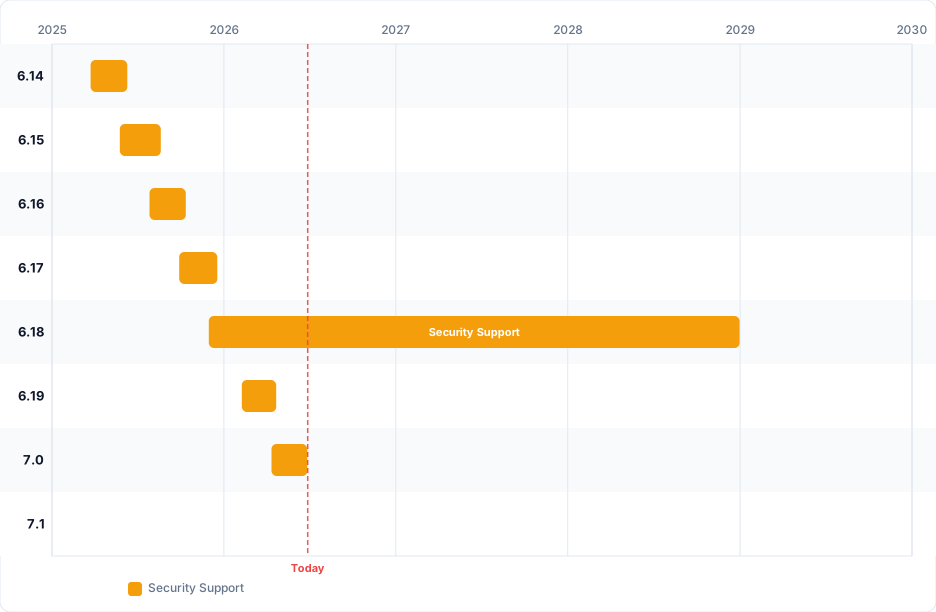
| Version | Released | Security Support | Latest |
|---|---|---|---|
|
7.2
|
16 Aug 2026 |
Active
|
7.2.8
25 Sep 2026
|
|
7.1
|
14 Jun 2026 |
02 Sep 2026
Ended 3 weeks ago
|
7.1.13
02 Sep 2026
|
|
7.0
|
12 Apr 2026 |
27 Jun 2026
Ended 3 months ago
|
7.0.14
27 Jun 2026
|
|
6.19
|
08 Feb 2026 |
22 Apr 2026
Ended 5 months, 1 week ago
|
6.19.14
22 Apr 2026
|
|
6.18
LTS
|
30 Nov 2025 |
31 Dec 2028
Ends in 2 years, 3 months
|
6.18.54
25 Sep 2026
|
|
6.17
|
28 Sep 2025 |
18 Dec 2025
Ended 9 months, 1 week ago
|
6.17.13
18 Dec 2025
|
|
6.16
|
27 Jul 2025 |
12 Oct 2025
Ended 11 months, 2 weeks ago
|
6.16.12
12 Oct 2025
|
|
6.15
|
25 May 2025 |
20 Aug 2025
Ended 1 year, 1 month ago
|
6.15.11
20 Aug 2025
|
About Linux Kernel
The Linux kernel's version numbers don't carry the significance they might suggest. Linus Torvalds bumps the major number when the minor number feels too large to keep track of, not because of some milestone, which is why kernel 7.0 and 7.1 have already shipped without marking any dramatic shift from the 6.x series. What actually matters for tracking support is whether a given release is a short-lived stable kernel or one of the small number designated as long-term support.
Linux Kernel Lifecycle Explained
Most kernel releases are ordinary stable releases, superseded by the next one after roughly two months, at which point they stop receiving any further fixes. A small subset of releases are designated long-term support (LTS), and these get years of backported security and bug fixes instead. LTS support windows have shifted more than most software in recent years: they ran six years historically, were cut to a 2-year default in 2023 as maintainers cited burnout from supporting so many branches at once, and were then partially extended again in early 2026 after industry pushback. As it stands now, Linux 5.10 and 5.15 are supported for six and five years respectively, 6.6 and 6.12 for four years each, and 6.18 for at least three years, with further extensions possible depending on industry demand.
Here's the important distinction for how much this actually matters in practice: unlike a language runtime or framework, the raw upstream kernel.org lifecycle isn't usually what determines real-world risk. Linux distributions like Debian, Ubuntu, and RHEL take a specific kernel version and back-port security fixes into it for the life of that distribution release, often well past the point where kernel.org itself has stopped maintaining that exact version. So a server running "an EOL kernel version" by kernel.org's own tracking may still be fully patched, because its distribution vendor is handling security fixes independently. The distribution's own end of life date, covered on this site's Debian and CentOS pages among others, is generally the more meaningful thing to track for production risk than the raw kernel.org branch status.
Frequently Asked Questions
What is the end of life Linux kernel?
Any kernel version, LTS or otherwise, that has passed its final maintained release and no longer receives updates from kernel.org is end of life. For non-LTS stable kernels this happens roughly two months after release; for LTS kernels it happens at the end of their multi-year support window, which varies by version.
Is Linux kernel 7.0 released?
Yes. Linux 7.0 shipped in 2026, following directly after the 6.x series once the minor version number reached a point where Torvalds chose to roll it over. It's a normal continuation of kernel development, not a major architectural break.
Is kernel 6.16 LTS?
No. The current set of LTS-designated kernels is 5.10, 5.15, 6.1, 6.6, 6.12, and 6.18. Kernel 6.16 isn't on that list, which means it was a standard stable release with only a couple of months of support after its successor shipped.
When did Linux kernel 6.8 release?
Linux 6.8 was released on March 10, 2024. Like other non-LTS releases, it received only a few months of updates before being superseded by 6.9.