

Symfony End of Life - Dates and Lifecycle
Symfony is a PHP framework and set of reusable components for building web applications, powering large parts of the PHP ecosystem including Laravel's underlying components.
Last updated 8 August 2026
36
Versions tracked
32
At EOL
4
Supported
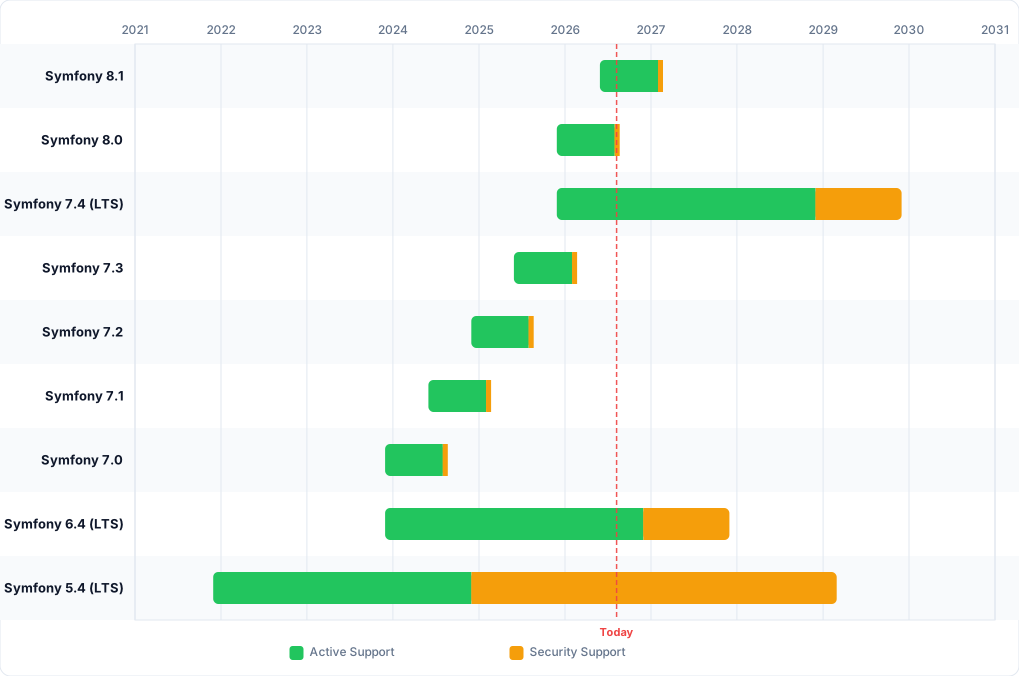
All versions
| Version | Released | Active Support | Security Support | Latest |
|---|---|---|---|---|
|
8.1
|
29 May 2026 |
31 Jan 2027
Ends in 4 months, 1 week
|
31 Jan 2027
Ends in 4 months, 1 week
|
8.1.7
15 Sep 2026
|
|
8.0
|
27 Nov 2025 |
31 Jul 2026
Ended 1 month, 3 weeks ago
|
31 Jul 2026
Ended 1 month, 3 weeks ago
|
8.0.16
29 Jul 2026
|
|
7.4
LTS
|
27 Nov 2025 |
30 Nov 2028
Ends in 2 years, 2 months
|
30 Nov 2029
Ends in 3 years, 2 months
|
7.4.19
15 Sep 2026
|
|
7.3
|
29 May 2025 |
31 Jan 2026
Ended 7 months, 3 weeks ago
|
31 Jan 2026
Ended 7 months, 3 weeks ago
|
7.3.11
28 Jan 2026
|
|
7.2
|
29 Nov 2024 |
31 Jul 2025
Ended 1 year, 1 month ago
|
31 Jul 2025
Ended 1 year, 1 month ago
|
7.2.9
31 Jul 2025
|
|
7.1
|
31 May 2024 |
31 Jan 2025
Ended 1 year, 7 months ago
|
31 Jan 2025
Ended 1 year, 7 months ago
|
7.1.11
29 Jan 2025
|
|
6.4
LTS
|
29 Nov 2023 |
30 Nov 2026
Ends in 2 months, 1 week
|
30 Nov 2027
Ends in 1 year, 2 months
|
6.4.46
15 Sep 2026
|
|
7.0
|
29 Nov 2023 |
31 Jul 2024
Ended 2 years, 1 month ago
|
31 Jul 2024
Ended 2 years, 1 month ago
|
7.0.10
26 Jul 2024
|
About Symfony
Symfony has been part of the PHP ecosystem for two decades, and its reusable components now sit underneath much of that ecosystem too, including several pieces Laravel itself relies on. The project recently marked 20 years since its original 2005 release.
Symfony Lifecycle Explained
Symfony releases on a fixed, predictable schedule: a patch update roughly every month (bug fixes only), a minor version every six months in May and November (new features, no breaking changes), and a new major version every two years, always in November of odd years. Major versions can contain breaking changes.
The major and LTS releases in each two-year cycle aren't the same thing, and they don't ship on their own separate schedules either, Symfony develops them together and releases them on the same day. The final minor of the outgoing branch (for example, 6.4) becomes that branch's LTS release, while the new major (7.0) ships simultaneously with the same features but with deprecated code removed. This gives teams a choice: upgrade to the LTS minor first to see deprecation warnings and fix them at a comfortable pace, then move to the new major once ready, or jump straight to the major if the codebase is already clean. Standard (non-LTS) releases get 8 months of bug fixes and 8 months of security fixes. LTS releases get 3 years of bug fixes and 4 years of security fixes.
Symfony 5.4 LTS is a notable exception to its own schedule. Its security support was originally due to end in November 2025, but Ibexa, a company whose own DXP platform is built on Symfony 5.4, sponsored an extension pushing that date to February 2029. Symfony has said these extended security patches are published publicly through Packagist, so the benefit isn't limited to Ibexa's own customers, anyone still on Symfony 5.4 gets the extended coverage.
PHP Compatibility by Symfony Version
Symfony's PHP policy works differently than a fixed range. Each version has a stated minimum PHP requirement, but while that Symfony version is still maintained, it supports every PHP release that comes out afterward too, there's no upper cap. Once a Symfony version reaches end of life, its PHP support freezes at whatever the latest PHP version was on that date, running a newer PHP release against an EOL Symfony version isn't guaranteed to work.
| Symfony Version | Minimum PHP Version |
|---|---|
| 8.1 | 8.4.0 |
| 8.0 | 8.4.0 |
| 7.4 | 8.2.0 |
| 7.3 | 8.2.0 |
| 7.2 | 8.2.0 |
| 7.1 | 8.2.0 |
| 7.0 | 8.2.0 |
| 6.4 | 8.1.0 |
| 6.3 | 8.1.0 |
| 6.2 | 8.1.0 |
| 6.1 | 8.1.0 |
| 6.0 | 8.0.2 |
| 5.4 | 7.2.5 |
| 5.3 | 7.2.5 |
| 5.2 | 7.2.5 |
| 5.1 | 7.2.5 |
| 5.0 | 7.2.5 |
| 4.4 | 7.1.3 |
| 4.3 | 7.1.3 |
| 4.2 | 7.1.3 |
| 4.1 | 7.1.3 |
| 4.0 | 7.1.3 |
| 3.4 | 5.5.9 |
| 3.3 | 5.5.9 |
| 3.2 | 5.5.9 |
| 3.1 | 5.5.9 |
| 3.0 | 5.5.9 |
| 2.8 | 5.3.9 |
| 2.7 | 5.3.9 |
| 2.6 | 5.3.3 |
| 2.5 | 5.3.3 |
| 2.4 | 5.3.3 |
| 2.3 | 5.3.3 |
| 2.2 | 5.3.3 |
| 2.1 | 5.3.3 |
| 2.0 | 5.3.2 |
Frequently Asked Questions
Is Symfony still used?
Yes, it remains one of the most widely used PHP frameworks, both directly and as underlying infrastructure for other tools, with regular releases continuing on its fixed six-month and two-year cadence.
Is Symfony 6.4 LTS supported?
Yes. Symfony 6.4 LTS is in Security Support through November 2027, having already passed its Active Support window in November 2026.
Is Symfony harder than Laravel?
This is a common comparison without a single objective answer. Symfony is generally considered more configuration-heavy and flexible, giving developers finer control at the cost of more upfront setup, while Laravel favors convention and sensible defaults to get started faster. Many developers who learn Laravel first find Symfony's underlying components familiar, since Laravel itself uses several of them.
How old is Symfony?
Symfony first released in 2005, making it one of the longest continuously maintained frameworks in the PHP ecosystem, with the project marking 20 years of development.